Best States to Start a Business in 2026 (and Worst, too!)
Choosing where to start a business affects more than paperwork. It changes how much cash you need to launch, how much tax complexity you take on, how easy it is to hire, how close you are to customers, and how much room you have to recover from early mistakes.
This guide compares the best states to start a business in 2026 by business model, not just by a single national ranking. Use it to narrow your shortlist, pressure-test your assumptions, and decide where your company can start strong.
Quick Answer: The Best States to Start a Business in 2026
For most founders, Florida, Texas, North Carolina, South Dakota, Wyoming, Montana, Washington, Utah, Georgia, and Colorado belong on the shortlist.
But the best state depends on the type of business you’re building and what your business plan actually requires. A remote consultant has different needs than a restaurant owner. An AI startup raising venture capital may still need to compare California, New York, or Massachusetts, even though those states are more expensive and less tax-friendly for many small businesses.
| Business type | States to compare first | Why they fit |
|---|---|---|
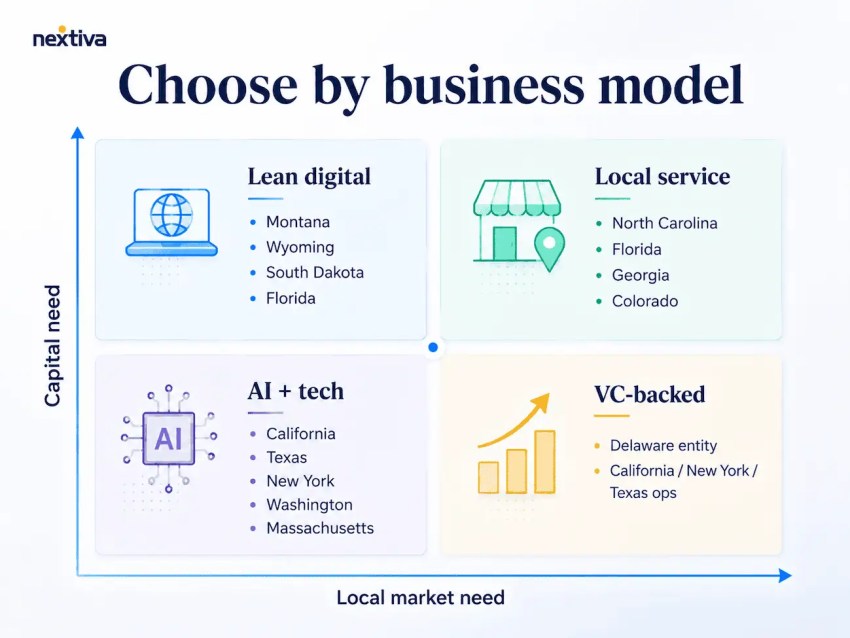
| Lean remote business | Montana, Wyoming, South Dakota, Florida | Low startup friction and lighter tax exposure |
| Local service business | Florida, North Carolina, Georgia, Colorado | Demand, labor access, and local growth |
| Tech or AI startup | California, Texas, New York, Washington, Massachusetts, Utah | Talent, investors, and enterprise buyers |
| Tax-sensitive founder | Wyoming, South Dakota, Florida, Montana | Low or no personal or corporate income tax exposure |
| Main-street expansion | Texas, Georgia, North Carolina, Florida, Colorado | Larger markets and SBA lending access |
The key is finding the ideal location for your model, because a bad location can undermine even a promising company. A state that looks strong on taxes may be weak for hiring. A state with deep venture capital may be too expensive for a bootstrapped founder. And a low filing fee will not help much if your customers, employees, or operations are somewhere else.
What Makes a State Good for Starting a Business?
A useful startup ranking should not overvalue one metric. Low LLC fees help, but they are only one line item. A large customer base helps, but it can also mean higher rent, wages, insurance, and competition.
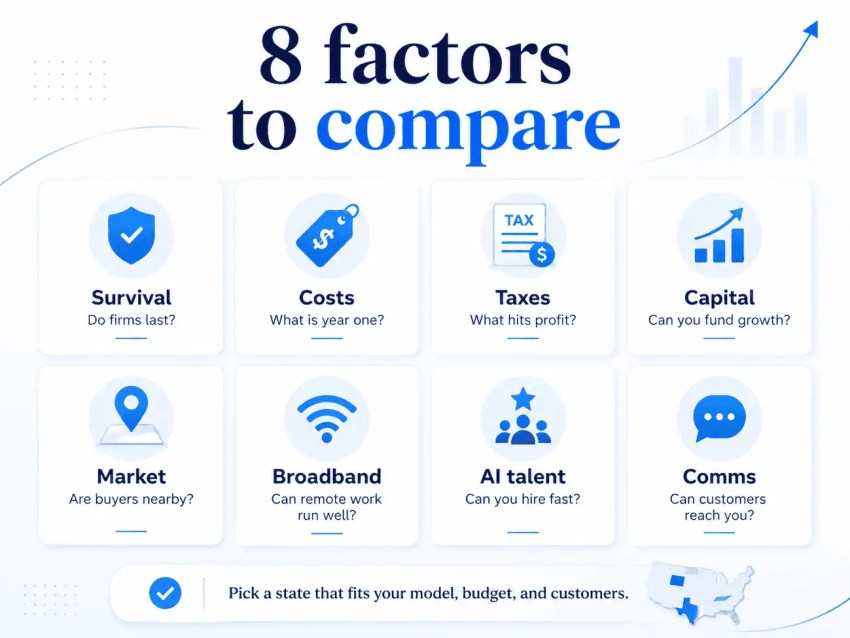
We evaluated states across eight factors:
| Factor | What to ask | Why it matters |
|---|---|---|
| Survival indicators | Do new firms stay open? | Shows startup durability and risk |
| Start-up costs | What does year one cost? | Protects limited startup cash |
| Tax climate | What hits profit? | Affects reinvestment and compliance |
| Capital access | Can you finance growth? | Matters for equipment, hiring, and expansion |
| Business formation activity | Is the market strong? Are buyers nearby? | Critical for local services and retail |
| Broadband readiness | Can remote work run well? | Supports cloud tools, VoIP, payments, and video |
| AI talent/tech ecosystem | Can you hire or adopt fast? | Important for tech and AI-enabled operations |
| Communication readiness | Can customers reach you? | Reduces missed calls, slow follow-up, and lost revenue |
The U.S. Census Bureau’s Business Formation Statistics are useful because they provide timely, high-frequency information on new business applications and formations.[1] Survival data from the U.S. Bureau of Labor Statistics is useful for economic analysis of risk and business climate because it shows how many establishments remain open after each year of operation.[2] But business applications alone do not prove a state is easy to operate in. High formation can signal demand, competition, or both.
Before You Pick a State, Separate Formation From Operations
Many founders search for the “best state to form an LLC” when they really need to answer a different question: Where will the business actually operate?
Your formation state is where you create the entity. Your operating state is where you work, hire, sell, store inventory, serve customers, or own property. Those can be different, but separating them can create extra filings.
That is why a Wyoming or Delaware entity is not automatically better for every founder. If you live in Arizona, serve customers in California, and form in Wyoming, you may still have registration, tax, payroll, or sales-tax obligations outside Wyoming.
Use this rule of thumb:
- Local business: Usually start with the state where customers and operations are located.
- Remote service business: Compare your home state against low-friction states, then check nexus.
- E-commerce company: Model sales tax, inventory, warehouse, marketplace, and fulfillment rules.
- VC-backed startup: Ask counsel and investors before choosing entity structure.
- Franchise or regulated business: Local licensing and insurance may matter more than filing fees.
This is not legal or tax advice. It is a practical warning: the cheapest state on paper can become expensive if it adds duplicate compliance work.
10 Best States to Start a Business
1. Florida
Best for: Local services, remote-first companies, creators, hospitality, consumer services, real estate-adjacent businesses, and professional services.
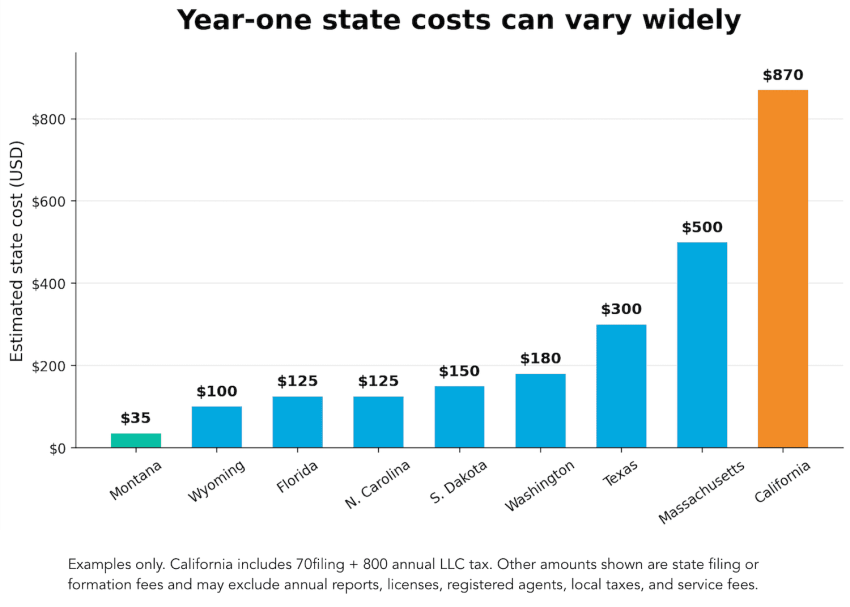
Florida is one of the strongest all-around picks because it combines low personal tax friction with a large and growing customer base. The state has no personal income tax, and a new Florida LLC costs $125 to form: a $100 filing fee plus a required $25 registered agent fee.[4]
Florida works for more than tourism. Miami, Tampa, Orlando, Jacksonville, and South Florida all support local services, health care, home services, logistics, retail, hospitality, and professional services. Remote-first founders also get airports, coworking, broadband options, and a large in-state market at a relatively low cost compared with pricier coastal hubs.
Where Florida is strongest:
- Low personal tax friction: Helpful for many pass-through businesses.
- Strong demand: Population growth supports service and consumer categories, and small-business business growth was nearly 16% from 2017 to 2023.
- Remote-work fit: Major metros offer infrastructure without requiring a traditional office.
- Moderate formation cost: Not the cheapest, but manageable for most founders.
Check before filing: Florida can be crowded. Insurance, local permits, storm risk, commercial rent, and seasonal demand can change the math for restaurants, hospitality, home services, and retail.
Bottom line: Florida is a strong default shortlist state for founders who want demand, flexibility, and a lighter tax profile than many coastal states, with corporate taxes that rank as the 15th-lowest in the US.
2. Texas
Best for: High-growth companies, B2B services, energy, logistics, health care, manufacturing, AI, software, and businesses that need a large market.
Texas gives founders scale in a thriving economy. Austin, Dallas-Fort Worth, Houston, and San Antonio each support different startup types. Austin is known for software and venture-backed companies. Dallas-Fort Worth gives businesses access to corporate buyers, logistics, and professional services. Houston is strong for energy, health care, industrial services, and international business.
Texas has no state personal income tax, which means more disposable income for founders and owners, but it is not automatically cheap. The state filing fee for a Texas LLC certificate of formation is $300.[5] Businesses may also face the Texas franchise tax, and property taxes can be high.
Where Texas is strongest:
- Large customer base: Texas gives founders access to one of the largest state economies in the country.
- Multiple startup hubs: Founders can choose a metro that fits their industry.
- Capital access: Banks, SBA lenders, angel investors, and venture capital networks are active across the state’s major metropolitan areas, supporting different operating models and stages of growth.
- Talent depth: Texas has several large labor markets instead of a single startup corridor.
Check before filing: Do not judge Texas by income tax alone. Model franchise tax, property taxes, payroll costs, rent, insurance, metro-level competition, and overall operating costs.
Bottom line: Texas is best when you need scale, hiring depth, capital, and access to corporate customers.
3. North Carolina
Best for: Service businesses, professional services, health care, logistics, biotech, software, and regional growth companies.
North Carolina offers a strong balance of cost, talent, and market depth. Raleigh, Durham, Chapel Hill, Charlotte, Greensboro, and Winston-Salem give founders several operating bases rather than one expensive hub.
The state also has one of the most attractive corporate tax profiles among states that still levy corporate income tax. North Carolina’s corporate income tax rate is scheduled to phase down and eventually reach zero, though founders should confirm current rates with the state before making tax decisions.[6]
Where North Carolina is strongest:
- Balanced cost profile: Lower cost than California, New York, Massachusetts, and New Jersey.
- Talent access: The Research Triangle supports software, biotech, life sciences, and professional services.
- Regional market: Charlotte and the Triangle make it easy to serve the Southeast and Mid-Atlantic.
- Business durability: The state frequently scores well on survival and operating-cost indicators.
Check before filing: Growth has raised housing, wages, and office costs in the Triangle and Charlotte. Compare city-level costs before choosing a metro.
Bottom line: North Carolina is one of the best operating bases for founders who want talent, customers, and manageable cost.
4. South Dakota
Best for: Lean remote companies, digital services, tax-sensitive founders, solo operators, consultants, and businesses selling nationally.
South Dakota keeps the startup equation simple. It has no personal income tax and no corporate income tax. State filing costs are moderate, and the tax climate is favorable compared with most states.
The trade-off is market size. A local restaurant group, specialty retailer, or home services company may find stronger demand in Florida, Texas, North Carolina, Georgia, or Colorado. But a remote service company, consulting firm, e-commerce brand, or digital product business may not need a large local market.
Where South Dakota is strongest:
- Low tax friction: Helpful for founders who sell nationally.
- Lean operating fit: Works especially well for remote and tax-sensitive founders comparing states for startups when they do not need a big local customer base.
- Simple decision-making: Fewer structural costs can help small teams stay focused.
Check before filing: Local demand, local hiring, and venture capital are limited. Specialized hiring will often require remote recruiting.
Bottom line: South Dakota is a strong choice for lean businesses that can sell beyond the state.
5. Wyoming
Best for: Remote-first founders, consultants, holding companies, digital products, and tax-sensitive businesses.
Wyoming is popular because it offers no personal income tax, no corporate income tax, and a reputation for simple business administration. The standard state filing fee for a Wyoming LLC is commonly listed at $100, with additional online processing costs when filing online.[7]
Wyoming can be a good fit when the business sells nationally and does not depend on a local market. It can also be a mismatch when the founder lives and operates somewhere else but assumes a Wyoming LLC removes all other state obligations.
Where Wyoming is strongest:
- Low tax friction: Useful for some remote-first companies.
- Simple legal structure: Popular for small entities and holding companies.
- Remote-company fit: Works when customers are national or online.
Check before filing: Wyoming may be your legal home, not your operating home. If you live, hire, store inventory, or sell heavily in another state, you may still need to register or pay taxes there.
Bottom line: Wyoming is useful for some remote-first founders, but it is not a magic tax shortcut.
6. Montana
Best for: Bootstrapped founders, consultants, small agencies, creators, outdoor services, specialty goods, and lean remote businesses.
Montana is one of the lowest-cost states to form an LLC. The Montana Secretary of State lists domestic LLC articles of organization at $35.[8] Montana also has no general sales tax, which can simplify some sales and customer pricing questions.
Low filing cost does not guarantee success. But it does reduce the first barrier for founders testing a business idea. For a solo consultant, designer, bookkeeper, content creator, outdoor services company, or small remote agency, that can matter.
Where Montana is strongest:
- Very low filing cost: One of the lowest state LLC filing fees.
- No general sales tax: Useful for many consumer and product businesses.
- Lean founder fit: Good for low-overhead operations.
Check before filing: Broadband can vary by address, especially outside larger towns. The local market is small, so many businesses need regional or national customers.
Bottom line: Montana is practical for founders who want to keep early business costs low and can sell beyond the local market.
7. Washington
Best for: Software, cloud, AI, enterprise services, logistics, professional services, and companies that need technical talent.
Washington is not the cheapest state, but it is one of the strongest for technology-driven businesses. Seattle’s talent base is hard to match because of Amazon, Microsoft, and the broader cloud and software ecosystem.
Washington has no individual income tax, but it uses a business and occupation tax on gross receipts. That matters because a gross-receipts tax can apply even when profits are thin.[9]
Where Washington is strongest:
- Technical talent: Strong workforce for software, cloud, and AI.
- Enterprise ecosystem: Access to large companies, advisors, and experienced operators.
- Remote-work readiness: Strong fit for distributed teams that still need a tech hub.
Check before filing: Cost of living, wages, commercial rent, and gross-receipts taxes can make Washington expensive.
Bottom line: Washington works when ecosystem depth matters more than low operating cost.
8. Utah
Best for: SaaS, sales-led startups, professional services, outdoor brands, consumer services, and growth companies.
Utah’s startup ecosystem has matured, and it has become increasingly popular with founders. The Silicon Slopes corridor gives founders access to SaaS operators, sales talent, investors, and experienced tech leaders without the same cost profile as the Bay Area or New York.
Utah is not the lowest-tax state. Its value is ecosystem density. Founders in B2B software, sales technology, marketing technology, professional services, and outdoor-adjacent brands can find peers and talent.
Where Utah is strongest:
- SaaS and sales talent: Helpful for B2B software and growth companies.
- Lower cost than coastal hubs: Still more affordable than California or New York.
- Founder network: Alumni from past tech wins support the next generation of startups.
Check before filing: Competition for experienced tech workers has increased. Salt Lake City and nearby markets are not as inexpensive as they were a decade ago.
Bottom line: Utah is a credible alternative for founders who want tech density without California costs.
9. Georgia
Best for: Local services, logistics, professional services, franchises, health care, film, retail, and regional companies.
Georgia is a strong regional base for growing companies. Atlanta gives founders a major airport, easy access across the Southeast, corporate buyers, universities, health care systems, and a deep labor market. Secondary cities can offer lower operating costs while keeping the business connected to the region.
Georgia is also useful for founders who need customers and operations in the same region. Logistics, health care, home services, professional services, retail, and franchise models all have room to grow.
Where Georgia is strongest:
- Regional access: Strong base for serving the Southeast.
- Atlanta ecosystem: Corporate buyers, airport access, talent, and capital.
- Multiple city options: Founders can compare Atlanta with lower-cost secondary markets.
Check before filing: Atlanta is competitive and can be expensive. Compare suburbs and secondary cities before committing.
Bottom line: Georgia is strong for founders who want a Southeast operating base with access to buyers and talent.
10. Colorado
Best for: Remote teams, professional services, outdoor brands, health and wellness, software, and companies serving the Mountain West.
Colorado offers a strong mix of talent, quality of life, broadband, and regional access. Denver, Boulder, Lakewood, Aurora, Colorado Springs, and Fort Collins each support different founder profiles.
Colorado is not the lowest-cost state. Housing and labor costs can be high, and the tax climate is not as favorable as Wyoming, South Dakota, or Florida. But the state remains attractive for founders who need workers, customers, and a remote-friendly culture.
Where Colorado is strongest:
- Talent and lifestyle: Helpful for recruiting and retention.
- Remote-work culture: Strong fit for distributed teams.
- Western market access: Good base for serving nearby states.
Check before filing: City-level costs vary widely. Denver and Boulder are not the same as Colorado Springs, Fort Collins, or smaller markets.
Bottom line: Colorado is strong when talent, remote-work infrastructure, and regional access matter more than the lowest tax bill.
How Start-Up Costs Change the Math
Start-up costs matter most when founders have very little cash to work with. Nextiva’s 2026 Entrepreneur Survey found that 34% of founders launched with $1,000 or less, and 61% launched with $5,000 or less.
At those budgets, state filing fees are not just paperwork costs. If you launch with $1,000, a $35 filing fee and a $500 filing fee are very different. One is a small admin cost. The other can consume half your budget before you buy a domain name, tools, insurance, or a business phone number.
Formation costs can also create false signals. California’s LLC filing fee may look low in isolation, but California LLCs generally owe an $800 annual tax if they are organized or doing business in California.[10] Massachusetts charges a $500 LLC certificate filing fee and also requires annual filings.[11]
A founder should model the first five years, not just day one. Include:
- Formation fee: Articles of organization or certificate filing.
- Annual report fees: Recurring state filing costs.
- Registered agent fees: Required when you do not have an in-state address.
- Franchise or gross-receipts taxes: Can apply even when profit is low.
- Local licensing: City, county, industry, and professional licenses.
- Payroll and sales tax registration: Required once you hire or sell taxable products.
- Insurance: Often higher in states with storm, litigation, or property-risk exposure.
- Customer communication tools: Phone, SMS, email, appointment booking, and support channels.
A low-cost state helps, but only if your customers, compliance needs, and operations fit the choice.
Best States by Founder Type
Best for a lean remote founder
Best states: Montana, Wyoming, South Dakota, Florida.
Lean remote founders usually care about low filing costs, low tax friction, and reliable broadband. They may be consultants, designers, developers, content creators, e-commerce operators, bookkeepers, coaches, or fractional executives.
This group should not overpay for a local market it does not need. If customers are national, state selection should reduce friction and free more cash for distribution, customer service, and product development.
Decision tip: Do not use a remote domicile as a shortcut around taxes. If you live in one state, form in another, and sell heavily into a third, you may have obligations in all three.
Best for a local service business
Best states: Florida, North Carolina, Georgia, Colorado, Texas.
Local service businesses need customers nearby. Home services, health and wellness, restaurants, real estate services, legal services, accounting firms, auto repair shops, and retail businesses need local demand, local visibility, fast response, and enough workers.
For these companies, a low LLC fee helps, but it is not the main issue. Local licensing, insurance, labor, rent, and customer response time matter more.
A missed call can become a lost job.
This is where the startup plan should include communication readiness from the beginning: call routing, voicemail-to-email, business texting, and appointment scheduling.
Decision tip: Form and register where you actually operate and serve customers. Local licensing, tax nexus, and service area requirements are tied to your physical footprint, so choosing a different state rarely reduces complexity and can create extra filings.
Best for AI-native or tech startups
Best states: California, Texas, New York, Washington, Massachusetts, Utah.
Tech startups need talent, investors, early adopters, and a network of people who understand the product category. Federal Reserve research shows AI adoption is rising across U.S. businesses, but adoption varies by survey, firm size, and industry.[12]
California remains hard to beat for venture-backed AI, with Silicon Valley and San Francisco still central to the state’s funding, talent, and startup ecosystem. But not every software business needs California. Texas, Washington, Massachusetts, Utah, and New York can provide technical talent, and enterprise buyers at different cost levels.
Decision tip: If you are raising institutional capital, talk with investors and counsel before selecting an entity structure. Many VC-backed companies still use Delaware C corporations, even if they operate elsewhere.
Best for a high-growth company seeking capital
Best states: Texas, California, New York, Massachusetts, Washington, Georgia, Colorado, North Carolina.
High-growth founders should optimize for capital access, talent, customer density, and exit options. State filing cost matters less if the company needs institutional investors, specialized hires, and enterprise customers.
But high-growth does not always mean coastal. Many B2B and vertical SaaS companies can build in Texas, Utah, Colorado, Georgia, or North Carolina and still sell nationally.
Decision tip: Choose your operating state separately from your legal entity structure. Your legal home, physical location, hiring footprint, tax nexus, and sales footprint can be different.
50-State Fit Snapshot
Use this table as a screening tool, not as legal or tax advice. The strongest fit shows where a state may make sense. The caution shows what to validate before filing.
| State | Strongest fit | Check before filing |
|---|---|---|
| Alabama | Manufacturing, local services | Broadband and local labor vary |
| Alaska | Niche local services, tourism | Distance and logistics costs |
| Arizona | Remote teams, real estate, services | Heat, water, wages, and growth pressure |
| Arkansas | Local services, low-cost operations | Capital access and market size |
| California | VC-backed tech, AI, media, biotech | High taxes, wages, rent, and compliance |
| Colorado | Remote teams, software, wellness | Housing and labor costs |
| Connecticut | Finance, professional services | High operating costs |
| Delaware | Legal entity formation | Often not the best operating state |
| Florida | Services, remote, hospitality, consumer | Competition, insurance, storm risk |
| Georgia | Southeast services, logistics, franchises | Atlanta costs and competition |
| Hawaii | Tourism, hospitality, local goods | Freight, rent, and market size |
| Idaho | Remote, local services, trades | Small market and talent depth |
| Illinois | Chicago market, logistics, services | Tax and compliance complexity |
| Indiana | Manufacturing, main-street business | Smaller VC ecosystem |
| Iowa | Agriculture, local services | Smaller tech market |
| Kansas | Local services, logistics | Market size and talent depth |
| Kentucky | Local services, low-cost operations | Capital ecosystem depth |
| Louisiana | Energy, hospitality, local services | Tax complexity and weather risk |
| Maine | Tourism, specialty goods | Seasonality and small market |
| Maryland | Federal contracting, health care | High costs and regulation |
| Massachusetts | Biotech, deep tech | $500 LLC filing and annual report fees |
| Michigan | Manufacturing, mobility, services | Uneven city-level markets |
| Minnesota | Professional services, health care | Tax and cost pressure |
| Mississippi | Low-cost local services | Capital access and workforce depth |
| Missouri | Local services, logistics | Mixed tax and metro profile |
| Montana | Lean remote, low-cost formation | Rural broadband and small market |
| Nebraska | Local services, agriculture | Smaller ecosystem |
| Nevada | Tourism, remote services | Fees and cyclical local demand |
| New Hampshire | Professional services, remote | Small local market |
| New Jersey | NYC-adjacent operations | High corporate tax burden |
| New Mexico | Low-cost local business | Smaller capital market |
| New York | VC, finance, media, enterprise | Taxes, rent, and wage costs |
| North Carolina | Services, tech growth | Rising metro costs |
| North Dakota | Energy, local services | Small labor pool |
| Ohio | Manufacturing, services, logistics | Competitive metro markets |
| Oklahoma | Energy, local services | Smaller market depth |
| Oregon | Lifestyle brands, consumer, tech | Tax and labor costs |
| Pennsylvania | Health, education | Tax complexity and local variation |
| Rhode Island | Local and coastal services | Small market and high cost |
| South Carolina | Manufacturing, services | Infrastructure varies by area |
| South Dakota | Lean remote | Small local market |
| Tennessee | Services, logistics | Rising metro costs |
| Texas | Scale, capital, tech, logistics | Franchise tax and property taxes |
| Utah | SaaS, sales-led startups, outdoor brands | Talent competition |
| Vermont | Specialty goods, local services | Small market and seasonality |
| Virginia | Government, tech, services | Higher Northern Virginia costs |
| Washington | Cloud, AI, enterprise services | Gross-receipts tax and high wages |
| West Virginia | Low-cost services | Limited capital and labor depth |
| Wisconsin | Manufacturing, services | Modest startup density |
| Wyoming | Remote LLCs, consulting, holdings | Nexus in operating states |
Remote-First Business: The State Decision Has Changed
Remote work changed state selection. A founder can form in one state, work from another, hire across several states, and sell nationwide. That flexibility helps, but it also adds compliance risk.
Domicile is not the same as operations
Your domicile is where the entity is formed. Your operating state is where you actually work, hire, store inventory, sell, or deliver services. If those are different, you may need foreign qualification, payroll registration, sales tax registration, or income tax filing in more than one state.
This is one reason “best state to form an LLC” content can mislead founders. Forming in Wyoming or Delaware may be sensible for some companies. It may be unnecessary overhead for a local business that only serves customers in Florida, Arizona, or North Carolina.
Broadband is now a core business utility
The Census Bureau tracks business formation because business applications and formations are an early signal of new business activity.[13] But forming a remote business is only the first step. Remote founders need stable internet, video calls, cloud software, payments, and communication tools.
Before choosing a home office, coworking space, or small retail location, check broadband availability at the address level. Do not rely only on state averages.
Communication tools replace physical presence
A founder no longer needs a downtown office to sound professional. A business phone system can route calls, send texts, capture voicemails, and keep customer conversations organized.
Nextiva’s small business VoIP platform includes calling, business SMS, video meetings, screen and file sharing, call routing, team chat, and a mobile app.[14] For small teams, that solves a basic startup problem: customers need to reach the business even when the founder is busy, serving another customer, traveling, or working after hours.
The AI Factor: Why It Matters by State
AI is becoming a normal part of small business operations. The Federal Reserve found that about 18% of firms had adopted AI by the end of 2025. Before a late-2025 methodology change, adoption grew 68% over the year ending in September.[15]
That does not mean every founder should move to an AI hub. It means AI readiness belongs in the operating plan.
AI affects founders in three ways:
- Competition: A local service business that uses AI for intake, scheduling, follow-up, and reviews can respond faster than a competitor that handles every message manually.
- Hiring: AI-literate employees, contractors, and agencies are easier to find in some markets than others.
- Customer expectations: Buyers increasingly expect quick answers, online booking, text confirmations, and support outside traditional business hours.
Nextiva’s XBert AI Receptionist is designed for that gap. It can answer calls, texts, and chats, book appointments, handle common questions, transfer complex requests, and capture leads.[16] This is especially relevant for founders in lean states where small teams cannot answer every inquiry in real time.
5 Toughest States for New Businesses
Some states are not bad places to build. They simply demand more capital, stronger margins, or a clear reason to be there.
California
California is the clearest trade-off in the country. It has unmatched talent, venture capital, universities, corporate customers, and AI activity. It also has high housing costs, high wages, complex taxes, and an $800 annual LLC tax for LLCs organized or doing business in the state.[17]
California can be the right state for venture-backed AI, biotech, media, gaming, climate, or deep-tech companies. It is often the wrong state for a low-margin business that can serve customers from somewhere else.
New Jersey
New Jersey gives businesses access to the New York City and Philadelphia markets. It also carries a high tax burden. The state has one of the highest top corporate income tax rates in the country, and its tax climate tends to rank poorly in business tax comparisons.[18]
Founders who need the local market may accept the trade-off. Founders who simply want Northeast access should compare Pennsylvania, Delaware, New York, and remote structures before filing.
Massachusetts
Massachusetts is one of the strongest states for biotech, deep tech, education, and research-driven startups. It is also expensive. The LLC certificate filing fee is $500, and LLCs must file annual reports.[19]
For a venture-backed biotech startup, that cost may be irrelevant. For a solo founder, it matters.
Hawaii
Hawaii works for tourism, hospitality, food, cultural products, and local services tied to the islands. It is harder for many other businesses because freight, labor, rent, and travel costs are high. The market is geographically isolated, and scaling outside the state can add logistics work.
Maryland and Rhode Island
Maryland and Rhode Island can work for specific industries. Maryland has federal contracting, health care, and proximity to Washington, D.C. Rhode Island has niche coastal and local business opportunities. But both can be tougher for early-stage founders because business costs, regulation, and local market size reduce the margin for error.
Build Business Infrastructure Before You Need It
State selection gets founders into trouble when it becomes the whole strategy. A good state can reduce friction. It does not answer calls, follow up with leads, schedule appointments, or create a customer experience.
Most founders should set up four systems before launch:
- Business phone number: Keep personal and business calls separate.
- Call routing: Send calls to the right person or backup path.
- Business texting: Confirm appointments and respond quickly.
- Customer conversation history: Keep calls, texts, emails, and notes visible.
Nextiva’s NEXT platform brings voice, SMS, email, social, reviews, and other customer conversations into one inbox.[20] This helps founders avoid the early-stage mess of separate phone apps, personal inboxes, spreadsheets, and sticky notes.
For founders opening in high-demand states like Florida, Texas, Georgia, and North Carolina, fast response time can separate a new company from an established competitor. For founders operating in lean states like Montana, Wyoming, and South Dakota, unified communication helps a small team look organized from the first interaction.
How to Choose Your State in 7 Steps
- Define the business model. Local service, remote digital, VC-backed, e-commerce, franchise, and professional services companies need different state advantages.
- Estimate first-year costs. Include state filing, annual reports, registered agent, licenses, insurance, payroll, sales tax setup, and communication tools.
- Map customers. If customers are local, choose demand. If customers are national, choose low friction and operational fit.
- Check taxes beyond income tax. Gross-receipts taxes, franchise taxes, annual LLC taxes, and local taxes can change the math.
- Check broadband at the address. This matters for remote teams, VoIP calls, payments, cloud software, and video meetings.
- Model hiring needs. Compare local talent, remote hiring, payroll registration, and wage expectations.
- Set up customer communication early. Do not wait until missed calls become missed revenue.
Choose the State That Matches How You Will Sell
Remember that lists of the best and worst states are only a starting point. The best states to start a business are the ones that fit how your company will make money.
A remote consultant should not choose a state for the same reasons as a restaurant owner. A VC-backed AI founder should not optimize for the same business costs as a local contractor. A service business in Florida may need phone coverage and appointment booking more urgently than a Wyoming holding company.
Use rankings to narrow the field. Then choose based on your business model, customer location, tax exposure, capital needs, hiring plan, and communication setup in a way that works for owners and workers alike.
Nextiva fits into that last part. A state can make it easier to start, but customer communication helps you stay open. A business phone system, unified inbox, and AI receptionist give founders a way to capture calls, route inquiries, book appointments, and follow up without building a full front office on day one.
Methodology and Verification Notes
This guide uses a practical scoring framework rather than a single universal ranking. We evaluated state fit across eight factors to assess the overall business environment: business survival, startup costs, tax climate, business formation activity, capital access, broadband readiness, AI and tech ecosystem maturity, and communication readiness.
Survival, startup costs, tax climate, and business formation activity received the most emphasis because they affect nearly every new business. Capital access, broadband readiness, AI ecosystem maturity, and communication readiness were used to refine the rankings based on growth potential, remote-work readiness, and business model fit.
Verified sources used: U.S. Census Bureau Business Formation Statistics; U.S. Bureau of Labor Statistics Business Employment Dynamics survival data; Federal Reserve AI adoption research; Tax Foundation state tax analysis; state secretary of state and department of revenue fee pages; SBA lending resources; and current Nextiva product pages.
Editorial cautions: This ranking is intended as a decision-support tool, not legal, tax, or financial advice. State filing fees, tax rates, annual report fees, and nexus rules change. Confirm current state requirements with the secretary of state, department of revenue, and qualified tax counsel before forming or registering a business. Third-party rankings and state-level data can help narrow the shortlist, but the best state depends on where the business actually operates, hires, sells, stores inventory, and serves customers.
Stay Connected Wherever Work Takes You
Elevate your brand with the best business phone system. The unified communications solution every small business needs.
Best State to Start a Business FAQs
For most founders, Florida, Texas, North Carolina, South Dakota, Wyoming, Montana, Washington, Utah, Georgia, and Colorado are among the strongest choices. The best state depends on whether you need low taxes, local demand, venture capital, talent, or remote-work flexibility.
Montana is one of the lowest-cost states to form an LLC, with a $35 articles of organization filing fee listed by the Montana Secretary of State.[21]
Some of the best states with no income tax for independent business owners include Wyoming, South Dakota, Florida, Texas, and Washington. These states can reduce individual income tax exposure for pass-through business owners, but founders should still compare franchise taxes, gross-receipts taxes, sales taxes, property taxes, payroll obligations, and where the business actually operates.
The most business-friendly states in 2026 include Florida, Texas, North Carolina, South Dakota, Wyoming, Montana, Washington, Utah, Georgia, and Colorado. The right choice depends on your business model, tax exposure, capital needs, hiring plan, and whether you operate locally or remotely.
Wyoming may be the best state for LLC formation among our top 10 for remote-first and tax-sensitive founders, but it is not always best for local businesses. If you live and operate in another state, you may still need to register, file, or pay taxes there.
Delaware is often the default for venture-backed corporations, especially C corporations. A local service business or small LLC may not need Delaware. The extra registered agent, foreign qualification, and compliance work can outweigh the benefit.
No, it is not automatically one of the worst states for every founder. California is one of the best states for certain startups, especially venture-backed technology, AI, biotech, climate, media, and deep-tech companies. But it is also expensive. Choose California when you need the ecosystem, not because it is the default.
No. Cloud-based business phone systems work from almost anywhere with reliable internet. What matters is whether customers can reach you, whether calls route correctly, and whether your team can see conversation history.
[1] U.S. Census Bureau, Business Formation Statistics, https://www.census.gov/econ/bfs/index.html. Accessed June 23, 2026.
[2] U.S. Bureau of Labor Statistics, Entrepreneurship and the U.S. Economy: survival rates of establishments, https://www.bls.gov/bdm/entrepreneurship/bdm_chart3.htm. Accessed June 23, 2026.
[3] Tax Foundation, 2026 State Business Tax Climate Index / State Tax Competitiveness Index, https://taxfoundation.org/research/all/state/2026-state-tax-competitiveness-index/. Accessed June 23, 2026.
[4] Florida Department of State, Division of Corporations, LLC Fees, https://dos.fl.gov/sunbiz/forms/fees/llc-fees/. Accessed June 23, 2026.
[5] Texas Secretary of State, Form 205 Certificate of Formation – Limited Liability Company, https://www.sos.state.tx.us/corp/forms/205_boc.pdf. Accessed June 23, 2026.
[6] North Carolina Department of Revenue, Corporate Income and Franchise Tax Rates, https://www.ncdor.gov/taxes-forms/corporate-income-franchise-tax/corporate-income-and-franchise-tax-rates. Accessed June 23, 2026.
[7] Wyoming Secretary of State, Business Center forms and fee schedule, https://sos.wyo.gov/Business/Business.aspx. Accessed June 23, 2026.
[8] Montana Secretary of State, Business Services Filing Fees, https://sosmt.gov/business/filing-fees/. Accessed June 23, 2026.
[9] Washington Department of Revenue, Business and occupation tax, https://dor.wa.gov/taxes-rates/business-occupation-tax. Accessed June 23, 2026.
[10] California Franchise Tax Board, Limited liability company, https://www.ftb.ca.gov/file/business/types/limited-liability-company/index.html. Accessed June 23, 2026.
[11] Massachusetts Secretary of the Commonwealth / Mass.gov, Starting a limited liability company in Massachusetts, https://www.mass.gov/info-details/starting-a-limited-liability-company-llc-in-massachusetts. Accessed June 23, 2026.
[12] Federal Reserve Board, Monitoring AI Adoption in the U.S. Economy, April 3, 2026, https://www.federalreserve.gov/econres/notes/feds-notes/monitoring-ai-adoption-in-the-u-s-economy-20260403.html. Accessed June 23, 2026.
[13] U.S. Census Bureau, Business Formation Statistics, https://www.census.gov/econ/bfs/index.html. Accessed June 23, 2026.
[14] Nextiva, Small Business VoIP Phone System, Accessed June 23, 2026.
[15] Federal Reserve Board, Monitoring AI Adoption in the U.S. Economy, April 3, 2026, https://www.federalreserve.gov/econres/notes/feds-notes/monitoring-ai-adoption-in-the-u-s-economy-20260403.html. Accessed June 23, 2026.
[16] Nextiva, XBert AI Receptionist, Accessed June 23, 2026.
[17] California Franchise Tax Board, Limited liability company, https://www.ftb.ca.gov/file/business/types/limited-liability-company/index.html. Accessed June 23, 2026.
[18] Tax Foundation, 2026 State Business Tax Climate Index / State Tax Competitiveness Index, https://taxfoundation.org/research/all/state/2026-state-tax-competitiveness-index/. Accessed June 23, 2026.
[19] Massachusetts Secretary of the Commonwealth / Mass.gov, Starting a limited liability company in Massachusetts, https://www.mass.gov/info-details/starting-a-limited-liability-company-llc-in-massachusetts. Accessed June 23, 2026.
[20] Nextiva, NEXT Platform, Accessed June 23, 2026.
[21] Montana Secretary of State, Business Services Filing Fees, https://sosmt.gov/business/filing-fees/. Accessed June 23, 2026.