Key Differences & Which to Use
Key takeaways
Long codes are standard 10-digit phone numbers approved under A2P 10DLC with The Campaign Registry for commercial sends.
Short codes are five- or six-digit phone numbers pre-approved by SMS carriers for high-volume commercial sends. Costs are significantly higher than with a long code.
Toll-free numbers also have a 10-digit format, but swap the local area code for a toll-free prefix, with higher throughput than a long code.
Short code vs. long code SMS bottom line: Short codes have the best deliverability and throughput; long codes have the lowest costs.
You need a number provisioned for A2P (application-to-person) to send marketing texts. There are three types: a long code, a short code, and a toll-free number. Long code vs. short code is a matter of your volume and budget, with toll-free being the middle ground.
The number you pick changes what your customers see in their SMS app and affects throughput. Your ecommerce store will likely use a toll-free number or long code until it reaches a volume that justifies a short code’s cost.
Ecommerce SMS send volumes grew 40% in 2025, following a 31% rise in 2024. It isn’t unreasonable to predict an increase in your sends as well. The question is which to choose now, and when to make a change. We’ll cover all that today.
Join Omnisend to send marketing texts from a toll-free number we provide, verify, and set up for free
Quick sign up | No credit card required
What is a short code SMS?
A short code is a truncated phone number of five to six digits for sending high-volume commercial SMS and MMS within one country.
The image below shows a short code in action:
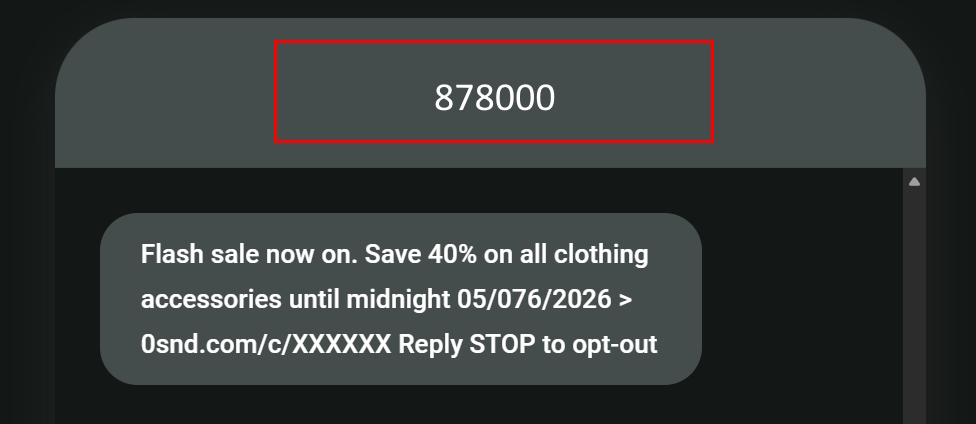
Carriers pre-approve short codes. They are therefore less likely to filter or block compliant short-code messages, meaning more of what you send arrives.
Short codes are more recognizable than long codes and toll-free phone numbers, a critical benefit if you’re a U.S. sender, since sender names do not show on SMS in the United States. Also, they support two-way texting, but are primarily for one-way campaigns.
You can only get a dedicated short code in 2026. Shared short codes, which multiple brands could use, were phased out by U.S. carriers in 2021.
Ecommerce brands sending 100,000+ texts use short codes over other number types to bypass per-number rate limits. A short code uses the carriers’ messaging infrastructure as a dedicated bulk-messaging route.
The cost for a dedicated short code runs $500 to $1,000/month plus initial carrier setup fees, and those costs don’t include message credits.
What is a long code SMS?
Long codes are standard 10-digit phone numbers with an area code on standard carrier networks. They’re no different visually from the number on your personal device, but are registered under A2P 10DLC with The Campaign Registry for commercial use:
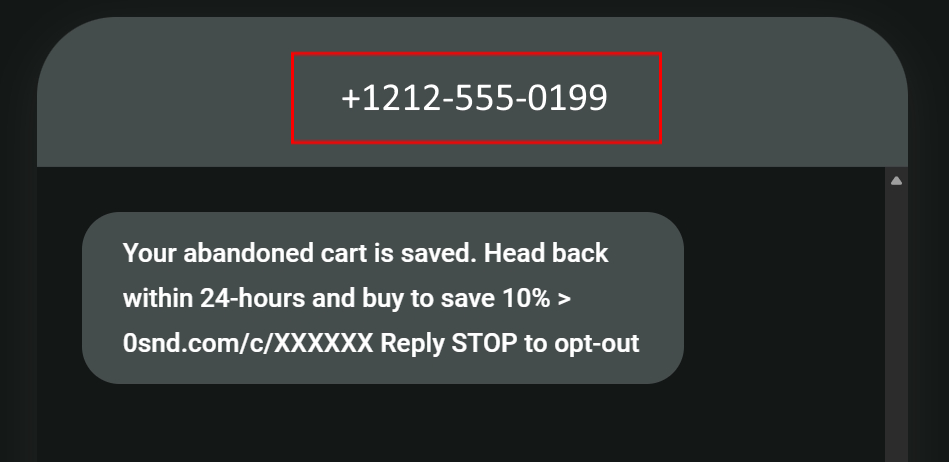
That registration tells carriers who the number belongs to and raises throughput for ecommerce marketing, though it stays below a short code.
The advantage of long codes is that they appear as standard numbers, so they are sometimes seen as more trustworthy than short codes for two-way conversations.
Ecommerce stores use long codes for local presence and conversational messaging, turning to short codes for broadcasts.
Toll-free numbers: The third option worth knowing about
A toll-free number is a 10-digit phone number without an area code. In its place is a toll-free prefix, such as 800 or 877, identifying it as a commercial number:
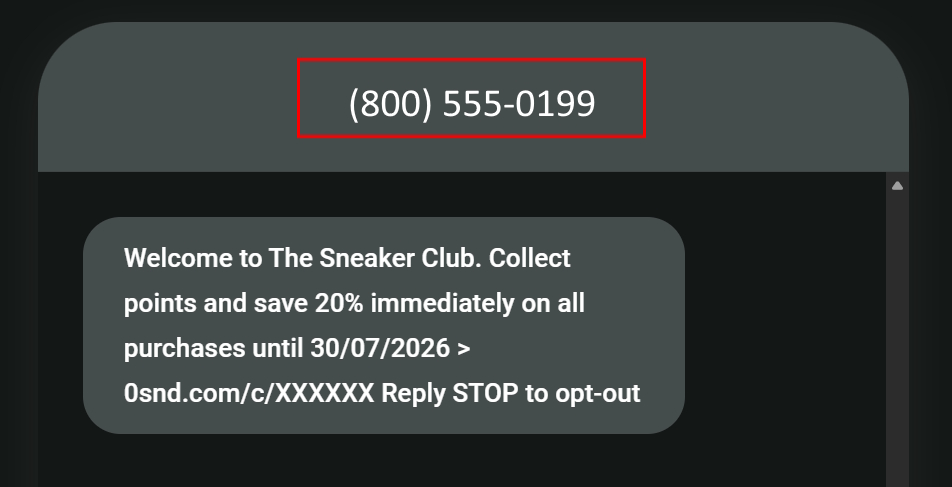
You can send and receive with a toll-free number, and the throughput is higher than with a long code, because carriers run verified toll-free numbers on business messaging routes.
Toll-free numbers require verification before sending commercial SMS. Omnisend uses toll-free numbers by default and submits the verification for you.
Additionally, Omnisend provides a toll-free phone number at no cost for sending SMS campaigns, so you’ll only pay for credits.
Using a toll-free number makes sense for small and mid-volume ecommerce senders who want a professional two-way business number without the cost of a short code.
Long code vs. short code: Key differences
The table below compares long code vs. short code vs. toll-free for SMS across their most critical features:
| Feature | Long code (10DLC) | Toll-free | Short code |
|---|---|---|---|
| Number format | 10 digits, local area code | 10 digits, toll-free prefix (800, 877, etc.) | Five or six digits |
| Throughput | Lowest, set by 10DLC trust tier | Higher than long code | Highest, hundreds of segments per second |
| Two-way messaging | Yes | Yes | Yes |
| Cost | Low, no monthly lease | Provided for free by Omnisend; other providers may have a small setup fee | Highest, $500 to $1,000/month plus setup |
| Carrier approval | A2P 10DLC registration | Toll-free verification | Per-use-case vetting and approval |
| Deliverability | High with 10DLC | High following verification | Highest, pre-approved route |
| Best for | Local presence, conversational sends | Mid-volume two-way at lower cost | High-volume bulk campaigns |
| Setup time | Days | Days | Weeks |
Now, let’s cover those key differences in more detail.
Throughput and sending speed
Throughput is how many messages a number sends per second. It decides how fast your message reaches your list, which matters for time-sensitive campaigns.
For example, if your flash sale runs for two hours, but sending to your large list takes three hours, many of your recipients get it after the offer ends.
Short codes have the highest throughput of circa 500+ messages per second, whereas long codes with A2P 10DLC typically send up to 75 per second. Toll-free numbers sit between them for handling over 100 messages per second.
You’ll need to consider a short code’s high throughput when sending mass text campaigns to 100,000+ contacts and handling high automation volume. Otherwise, a toll-free number or long code is sufficient for most needs.
Deliverability and carrier filtering
Short codes are pre-approved for commercial use by carriers, so they have an immediate deliverability advantage for large-volume sends.
Long codes require A2P 10DLC registration that ties your brand to the number and makes it legitimate for commercial use. Short codes are more trusted by carriers for high and mid-high sends, but for low-volume sends, there is no significant difference.
Toll-free numbers have high deliverability rates and offer similar performance to short codes for low-to-mid volume sends. Verifying the number as a legitimate business sender effectively delivers trust in your number for commercial use.
Verification is crucial, but deliverability also depends on having good sending practices, such as only sending to marketing opt-ins and keeping a clean list.
Cost comparison
There’s a clear winner for long code vs. short code costs. Long codes are significantly less expensive because there is no setup cost, only a one-time or annual fee for 10DLC registration, which allows you to send commercial SMS from the number.
A dedicated short code leases for $500 to $1,000 a month in the United States, plus setup fees, and then you have your message credits and plan on top. Prices depend on your SMS software.
Toll-free number costs depend on your number supplier. Omnisend provides a toll-free number for SMS, so you only pay for your Pro plan and the SMS credits you purchase. If you need a short code, you can contact our 24/7 customer service.
The per-message rate is the same across number types anyway. What differs is the cost of the number, not the price of each send. Likewise, your revenue potential doesn’t change based on the number type. Omnisend merchants generate an average of $0.74 in revenue per automated SMS sent, no matter if they’re using a long code, toll-free number, or short code. The choice between number types affects your program’s economics and scalability, not the revenue each message can generate.
Two-way messaging capability
Short codes, long codes, and toll-free numbers can all technically send and receive texts. But short codes are built for one-way mass sends, while long codes and toll-free numbers are the ones suited to two-way conversations.
Sending two-way messages makes the most sense from a long code or toll-free number. Long codes have an area code, useful for customer service in local regions.
A toll-free number is your best choice for general back-and-forth conversations, such as when customers reply to a shipping notification with a question, respond to a win-back offer with an inquiry, or engage with a post-purchase survey via reply.
Compliance and registration requirements
Long codes, short codes, and toll-free numbers require approval before being able to send commercial SMS.
Long codes require A2P 10DLC registration for U.S. sends. You’ll register your company and campaign with The Campaign Registry. Approval typically takes two to four weeks.
Short codes go through carrier review of your use case, message samples, and opt-in flow, with approval taking several weeks.
A toll-free number verification request is necessary for U.S. senders. A carrier request takes around five business days, but can take up to two weeks in some cases.
Omnisend provides guidance throughout toll-free number verification with a multi-step wizard and an AI assistant for consent proof validation. You can then see the verification status in your dashboard:

Requirements can also vary by country. UK senders work under different frameworks, covered in our SMS marketing UK guide.
Which number type should you use?
Short code vs. long code depends on your send volume, list size, and budget.
- A long code suits under 10,000 subscribers at a low cost and gives you an area code for localized campaigns
- Toll-free numbers handle up to around 100,000 subscribers with greater throughput and no lease costs
- Short codes are the best fit once your list goes past 100,000 due to their high throughput and approval by carriers
Use a short code if:
Your existing list sits at over 100,000 subscribers, or you’re expecting to reach that milestone within the next few months. For example, Divatress has around 70,000 SMS subscribers and sends frequent automated messages, putting it close to the scale where short code throughput starts becoming relevant.
A short code’s high throughput ensures you can send mass campaigns to all your contacts, and it will reach them with minimal delay. That matters most for time-sensitive sends like flash sales and BFCM, where a slow delivery means the message lands after the offer has ended.
Deliverability at volume is a short code’s most valuable feature, since the pre-approved route carries the highest ceiling. The trade-off is cost: you take on the monthly lease, which needs high volume to pay off.
Use a long code (10DLC) if:
Your list is fewer than 10,000, and you need a local number. Also, long codes work if you’re not sending frequently and intend to use two-way texting for customer service.
A2P 10DLC registration isn’t optional for U.S. sends, so you’ll need to get approval. An unregistered long code faces heavy filtering and can’t send commercial SMS reliably in the United States, so registration is a required first step.
Use a toll-free number if:
You’re a growing ecommerce store with a list size of up to 100,000. The professional prefix suits a national brand, with higher throughput than a long code’s area code.
Use cases include text automations, promotional campaigns, and two-way sends. You can run your welcome series, abandoned cart reminders, order information, BFCM promotions, and more with a toll-free number.
Toll-free is the right answer for most ecommerce stores for low-to-mid volume send needs. It’s the standard number provided for free by Omnisend.
Long code vs. short code for ecommerce marketing
You don’t pick a different number per use case. You pick one number (or sender setup) that covers everything you do.
So, the decision isn’t “long code for welcome, short code for flash sale,” it’s “given my whole mix of sends, which single number type serves all of them.”
That said, it helps to see what each type of send asks of your number. Here’s how the choice plays out across common ecommerce use cases:
- Cart abandonment > a long code or toll-free number. Your text will trigger per customer, requiring no significant throughput.
- Flash sale > short code for 100,000+ sends, toll-free for fewer. Throughput is crucial here, with a toll-free number suiting most stores.
- Welcome series > long code or toll-free. It’s the first message customers receive and doesn’t typically require large send volumes.
- BFCM > short code or toll-free number. It’ll probably be your highest-volume send of the year, so a short code is best, followed by toll-free.
- Post-purchase follow-up > long code or toll-free. Go toll-free if you’re a national retailer or long code if you sell locally and want an area code for two-way texts.
- Loyalty and winback texts > long code or toll-free. These are personalized texts, so a long code works well, or you can use a toll-free one.
Decide on long code vs. short code vs. toll-free based on your heaviest send. If you mostly send automated texts, a toll-free number covers you.
Start your SMS marketing program with Omnisend
Omnisend offers toll-free (default) and short codes (on request), not long codes. Your toll-free number is default, free, and generated automatically for you. Short codes require eligibility checks. Get in touch with our 24/7 support team for pricing.
Once you have your toll-free number or short code verified and set up, you can send automated texts and campaigns to your subscribers.
Global SMS capabilities and SMS credit prices between $0.007 and $0.009 per credit (based on volume) ensure you can reach all customers on budget.
Join Omnisend to build standalone SMS campaigns and multichannel automations
Quick sign up | No credit card required
FAQs
Short code vs. long code, what’s the difference?
A long code has 10 digits, and a short code has five to six digits. That’s the visual difference your customers see. Long codes are standard phone numbers with an area code, so they suit localized communication, whereas short codes are primarily for mass sends.
Which is better for SMS marketing — long code or short code?
A short code has higher throughput than a long code and is more recognizable, making it the better pick if your campaigns reach 100,000+ people. Long codes work well for local sends and smaller campaigns. A middle ground to consider is a toll-free number, which has better throughput than a long code and no lease fee, unlike a short code.
What is A2P 10DLC registration?
A2P 10DLC registration is a necessary verification step to send commercial SMS from a long code. Your long code requires approval via The Campaign Registry. Approval typically takes two to four weeks.
Can I use a long code for marketing SMS?
Yes, but it’s only reliable if it has A2P 10DLC registration. An unregistered long code is treated the same as a standard phone number and has an extremely low throughput and a high likelihood of triggering spam filters because of that.