Why expert hosting support still matters in the age of AI
Imagine for a moment an agency that manages more than 30 client websites. Late on a Friday afternoon, one of its WooCommerce stores returns intermittent 503 errors.
The site never fully goes down, which makes the issue even harder to track. Most customers can browse without a problem, but every so often checkout throws a 503 error. It may happen several times, stop for 20 minutes, then start again. The team can’t make it happen on demand, and there’s no recent deployment, plugin update, or traffic surge to point to.
You can look up what a 503 error means and get a list of the usual fixes. A chatbot will probably tell you to clear the cache, check your resources, or start disabling plugins. That advice may help with a straightforward case, but it doesn’t explain why this particular site keeps failing at checkout and then recovering on its own.
Someone needs to examine the server logs, review application performance traces, compare the failures with PHP thread utilization, and work out why checkout requests are behaving differently from the rest of the site. That takes access to the right data, but it also takes judgment.
In a situation like this, support quality isn’t a convenience or a pleasant extra. It affects lost orders, the agency’s relationship with its client, and how quickly the site returns to normal.
That’s the real question behind premium hosting support: not how well it answers routine questions, but what happens when the problem doesn’t have a routine answer.
What AI support is genuinely good at and why it handles most tickets well
AI support has earned its place in hosting. A large share of questions customers ask are known, documented, and relatively easy to classify.
Where can I find my SFTP credentials? How do I add a redirect? What does this error code mean? How do I clear the site cache?
For questions like these, an AI assistant connected to accurate product documentation can often respond faster than a human agent. It doesn’t need to search the knowledge base manually, and the customer doesn’t need to wait in a queue for someone to paste the relevant instructions into a chat. The answer may already exist in the documentation. AI simply makes it easier to find and apply.
The results can be substantial. According to Zendesk, its clients use generative AI to handle between 50% and 80% of their customer-support requests, although the percentage varies depending on the business and the kinds of questions customers ask.
The assistant is only as useful as the information behind it. With current, well-organized documentation, it can handle a lot of routine questions well. Once the source material is outdated, incomplete, or spread across several systems, the answers become less dependable. Gartner predicts that through 2026, organizations will abandon 60% of AI projects that aren’t supported by AI-ready data, which shows how much the quality of the underlying information matters.
None of this makes AI support a lesser form of support. For routine hosting tasks, it can reduce friction and get customers back to work quickly.
The meaningful distinction appears in the requests it cannot close. When the documented fixes don’t work, the symptoms point in several directions, or the problem involves a combination nobody has recorded before, retrieving a better article is no longer enough.
At that point, the support interaction moves from finding an answer to diagnosing a system.
The class of problem where AI support hits a ceiling
AI support works best when a problem has recognizable symptoms and a documented path to resolution. WordPress doesn’t always cooperate.
Intermittent failures with ambiguous causes
A site that throws a 500 error every time is usually easier to troubleshoot because the problem is always there when you look for it. It gets much harder when the error shows up every 20 minutes, only some customers can’t complete checkout, or the site slows down during certain stretches of the day.
These cases rarely produce one obvious clue. You may need to compare server logs, PHP thread usage, database activity, recent site changes, and the requests being processed when the failure occurred. Several explanations can look plausible at first, and the real cause may be an interaction between them.
WordPress sites are rarely alike. Two may use the same plugin, but differences in the theme, PHP version, cache setup, database, or traffic can change how that plugin behaves. It may run without issue on a quiet site, then start causing problems when it’s working alongside other plugins under heavier load. The documentation might explain each piece on its own without telling you much about why this particular mix is failing.
Performance problems that look like something else
A slow site isn’t always suffering from a lack of server resources. A plugin may be making excessive admin-ajax.php requests, a database query may be taking too long, or an external API may be holding PHP threads open while WordPress waits for a response.
At normal traffic levels, the slowdown may be easy to miss. During a sale or launch, though, those same slow requests can tie up the site’s PHP threads and start causing problems elsewhere.
Advice like turning on caching or disabling plugins may still be worth trying, but it puts most of the troubleshooting back on the customer. Kinsta’s APM tool can show what happened inside a slow request, including PHP activity, MySQL queries, and calls to outside services. The harder part is making sense of it—figuring out which pattern points to the real cause and which details can be ignored.
Novel interactions after platform changes
New platform releases create another blind spot because some failure patterns haven’t been documented yet.
WordPress 7.0, released on May 20, 2026, introduced an AI Client in core and raised the minimum supported PHP version to 7.4. Sites combining those changes with older themes, custom code, or legacy plugins can surface compatibility problems that don’t yet have a long history of support articles and accepted fixes.
Experience can make a difference here. If an engineer has already seen similar problems after the same update, they may know what to check first even when the error message points somewhere else. That can save a lot of trial and error, especially before there’s much documentation available.
These aren’t obscure edge cases for agencies and developers running production WordPress sites. They’re the problems that reveal whether support can do more than retrieve an answer, whether it can reason through a failure when the answer hasn’t been written yet.
What “expert support” actually means in practice and how to evaluate it
“Expert support” appears on plenty of hosting websites, but the phrase doesn’t tell you much by itself. Three practical details reveal more about the support you’ll receive.
Who answers the first message
A lot of hosting companies have generalists handle the easy questions, then send anything more technical up the chain. That works fine until your issue gets passed from one person to the next and you have to explain it all over again each time.
A generalist can explain how to clear a cache. They’re less likely to diagnose PHP thread exhaustion during a traffic spike without first collecting information for someone else.
Ask a prospective host who will answer when you open a ticket at 2 a.m. on Sunday. What technical background does that person have, and can they investigate the issue directly?
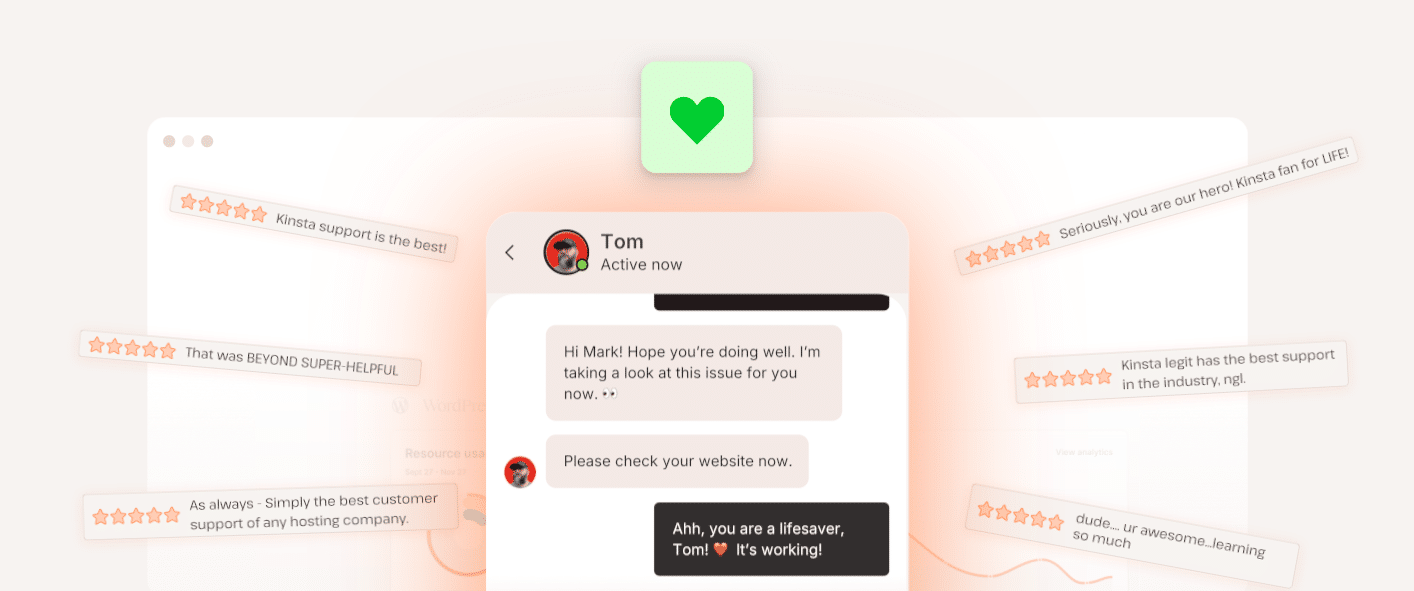
Kinsta puts every customer in touch with the same team of WordPress support engineers, regardless of plan size. There are no separate support tiers, and Kinsta reports an average first response time of under two minutes.
What information the engineer can access
Even an experienced engineer will struggle if the ticket begins with, “The site was slow earlier, but it seems fine now.”
The support operation should have access to enough historical data to investigate what happened rather than relying entirely on the customer’s recollection. In MyKinsta, customers can view resource usage, response-code breakdowns, caching behavior, server logs, and APM transaction data. Individual APM samples can also be shared with Kinsta’s support team.
MyKinsta notifications include an Ask Support option, so you can open a chat about the event you’re already viewing. The engineer sees what prompted the conversation and doesn’t have to start by asking you to explain everything from scratch.
How quickly the first useful answer arrives
First-response time can be misleading. A chatbot can respond instantly, and a human agent can answer within a minute by asking you to repeat information you’ve already supplied.
A fast reply doesn’t mean much if it only says someone will look into the problem. What matters is how long it takes to reach a person who can start investigating and give you a useful answer.
Kinsta reports an average first response of under two minutes and a 98% satisfaction rate. G2 reviewers often point to the team’s speed and WordPress knowledge as well. Some issues will still take time to solve, but customers generally aren’t waiting through several handoffs before they reach someone who understands the problem.
When support quality becomes a business decision
Premium support isn’t worth paying for on every website.
A personal blog receiving a few thousand visits each month, running a standard theme and a small set of well-maintained plugins, may rarely need anything beyond documentation and routine troubleshooting. For a site like that, choosing lower-cost hosting with AI-first support can be an entirely reasonable trade. Paying an extra $30 or more each month for access to WordPress engineers doesn’t make financial sense if the likely consequence of a problem is a mildly inconvenient afternoon.
The calculation changes when the site earns revenue, supports paying members, or belongs to a client with contractual expectations.
A WooCommerce store processing $5,000 in sales each day can’t treat a four-hour checkout failure as a minor support delay. An agency managing 20 client sites can’t afford to spend every incident collecting logs and performing the diagnosis before its host will engage. A membership platform with hundreds of subscribers needs a more useful response than being told to disable plugins one at a time on a live site.
In those situations, the cost of support failure isn’t the price of the ticket. It includes lost orders, staff time, missed service commitments, and damage to a client relationship.
Support quality can also change who has to participate when something goes wrong. Paul Letourneau of YEG Digital describes his experience this way:
“Kinsta’s chat support is incredible. They help my team solve problems directly, often without me even needing to get involved.”
That removes the agency owner as a required go-between. Project managers and developers can work with the host directly, while senior staff remains focused on the rest of the business.
Kinsta reports 24/7/365 access to WordPress engineers, an average first response in under two minutes, a 97% customer satisfaction rate, and a median resolution time of 47 minutes. A case study of our work with Gradient9 also connects round-the-clock expert support with the agency’s ability to scale confidently.
Those numbers won’t make premium hosting necessary for every site. They matter when the financial and operational cost of waiting for the right person already exceeds the difference in hosting price.
How Kinsta’s tooling changes the support conversation before it starts
A report like, “The site was slow earlier,” doesn’t give the support team much to go on. The site may be running normally again by the time someone checks it, so they still have to figure out what was happening at the time and whether PHP, the database, or an outside service was responsible.
MyKinsta gives customers and Kinsta’s engineers more evidence to work with.
Kinsta’s APM tool captures timestamped data about PHP processes, MySQL queries, and external HTTP calls. Instead of treating every slow page as a general hosting problem, an engineer can examine individual transactions and see where the request spent its time. A trace may point to inefficient plugin code, a slow database query, or an API that kept the request open while WordPress waited for a response.
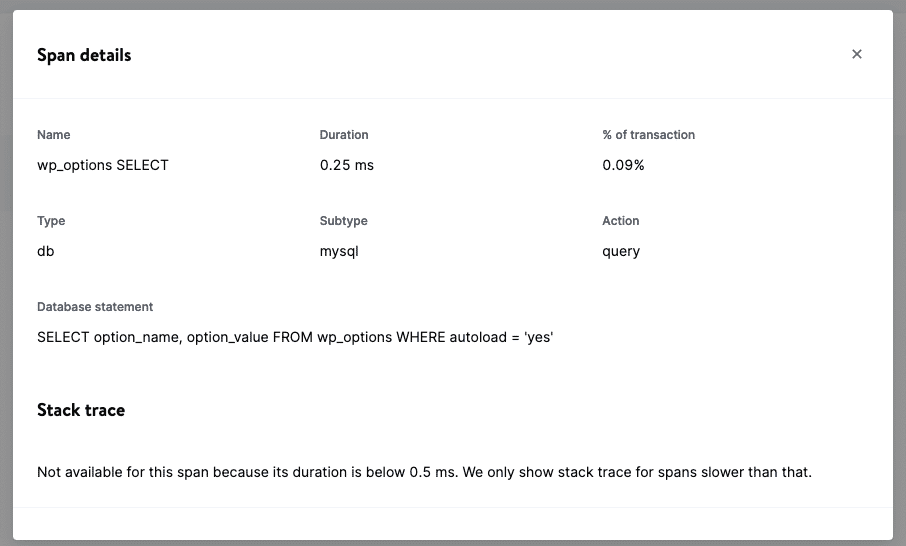
MyKinsta also shows traffic analytics, resource usage, response codes, cache activity, server logs, and user activity. That gives support a better picture of when the issue started and what else was happening around the same time.
Some investigations begin before the customer opens a chat at all. Kinsta checks every WordPress site on its platform once every three minutes. When that monitoring detects a site that isn’t loading, its engineers begin investigating and may contact the customer before the customer notices the outage.
It won’t fix every issue right away, but it cuts down on the guesswork. The engineer can look at what was happening around the time of the problem instead of starting with a long list of questions about what you saw.
Is premium hosting support worth paying for?
AI can answer many hosting questions faster than a human can, and there’s little reason to pay a premium merely to receive instructions that already exist in the documentation.
The real test comes when the usual fix doesn’t work.
For a small site, that may not matter much. If the occasional problem is more annoying than costly, lower-priced hosting with AI-first support may be perfectly adequate. The stakes are different for a store, membership site, or agency portfolio. In those cases, every hour spent working through a generic checklist can mean lost sales, frustrated users, or an unhappy client.
Expert support earns its value in those moments. Not because you’ll necessarily contact it often, but because an experienced engineer can investigate a failure that doesn’t have an obvious cause or a ready-made answer.
If you’ve ever been told to disable plugins one by one while a live site is having problems, you know how quickly general support can run out of useful answers. That may be manageable on a low-traffic site. It’s a much bigger problem when customers are trying to check out, or a client is waiting for an explanation. To that end, consider signing up for managed hosting or joining our Agency Partner Program to gain access to greater support and fewer tasks on your plate.

Kinsta
Carlo is a passionate lover of webdesign and front-end development. He has been playing with WordPress for more than 20 years, also in collaboration with Italian and European universities and educational institutions. He has written hundreds of articles and guides about WordPress, published both on Italian and international websites, as well as on printed magazines. You can find him on LinkedIn.