How to Find Your First CMMC Client as an MSP
Key Points
- MSPs can start a CMMC practice by identifying existing clients that hold DoW contracts, handle federal data, or operate within the Defense Industrial Base.
- Find CMMC prospects through SAM.gov, defense industry associations, manufacturing networks, APEX Accelerators, MEP programs, and relevant industry events.
- Qualifying signals include ITAR registration, DFARS compliance, NIST SP 800-171, AS9100 certification, defense manufacturing, and relationships with major defense primes.
- Strong CMMC prospects combine federal cybersecurity obligations with limited internal security resources, creating opportunities for MSP-managed compliance and IT services.
- A successful first CMMC engagement can generate referrals to other defense suppliers and subcontractors facing similar cybersecurity and compliance requirements.
Start your CMMC practice with a single client
CMMC (Cybersecurity Maturity Model Certification) is how the Department of War (DoW) confirms that defense contractors meet federal cybersecurity standards before they can win or keep contracts. It is a supply-chain requirement that applies to the contractors and suppliers that handle Controlled Unclassified Information (CUI) or Federal Contract Information (FCI), and to the managed service providers (MSPs) who manage those systems. These requirements have been part of DoW contracts since November 2025, and a July 2026 pause on the third-party certification step did not change the underlying need to protect federal data.
What most MSPs don’t know is that building a profitable CMMC practice can start with one client.
Once you land your first deal in the defense supply chain, you often earn access to a whole network of similar suppliers who need the same help. The opportunity is closer than many MSPs realize, because most already serve companies inside or next to the Defense Industrial Base (DIB).
After the NinjaOne webinar, CMMC Explained: What MSPs Need to Know Today, several MSPs asked a practical question; what is a dependable way to find that first CMMC client?
This blog covers where those clients are, how to recognize them, and how to open the conversation with confidence.
The opportunity in the defense supply chain
The DIB includes more than 300,000 organizations, and most are small and mid-size businesses that already rely on MSPs. Tens of thousands of these suppliers are in scope for CMMC today because they handle federal contract data. The work flows from the DoW to prime contractors, then to the subcontractors and suppliers beneath them, and finally to the MSPs who manage their systems.
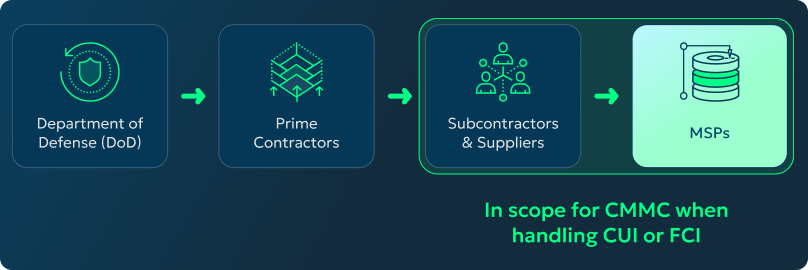
Your MSP comes into scope as soon as you handle CUI or FCI for a client. The scope follows a simple chain: your client is in scope, their IT environment is in scope, you manage that environment, so you are in scope too. That puts you in a strong position, because you already have a relationship with that client, and can add real value by helping them meet a requirement that supports their business.
Estimates project that the global CMMC consulting-services market will reach $2.8 billion by 2032, making this a lucrative area of specialization.
Where MSPs can find CMMC clients
Start with targeting companies that are already exposed to CMMC requirements.
You can build your list two ways, and it helps to run both at the same time. The first is to look at the clients you already serve, because some of them may already sit in the defense supply chain without either of you having framed it that way. The second is to look outward for new prospects you can approach as a knowledgeable CMMC partner.
- Start with your current book of business and ask which of your existing clients hold DoW contracts or handle government data, since those are existing CMMC opportunities.
- Use SAM.gov, the federal government’s searchable contractor database, to confirm whether a company is an active federal contractor. You can use this for a current client or a brand-new one.
- Connect with local defense industry associations and manufacturing networks to meet new suppliers and build a reputation as their CMMC partner.
- To find new prospects beyond your own network, look to the communities where defense manufacturers and suppliers already gather.
- National industry associations are a rich source, and include the following:
- National Defense Industrial Association (NDIA)
- Association of the United States Army (AUSA)
- National Center for Defense Manufacturing and Machining (NCDMM)
- National Tooling and Machining Association (NTMA)
- Precision Metalforming Association (PMA)
- Society of Manufacturing Engineers (SME)
- Aerospace Industries Association (AIA)
- Association for Manufacturing Technology (AMT)
Nearly every state also has its own manufacturing association filled with suppliers that serve larger defense contractors. Industry events are another strong option, such as the AUSA Annual Meeting, Sea-Air-Space, Modern Day Marine, SOF Week, WEST, and AFCEA TechNet, where the companies exhibiting either already meet CMMC requirements or expect to soon.
In addition, two government-connected groups, APEX Accelerators and the Manufacturing Extension Partnership (MEP), work directly with manufacturers pursuing government contracts and can point you toward companies preparing for CMMC.
How to identify companies that may need CMMC support
Once you have a company to look at, whether it is an existing client, an association member, or a name from SAM.gov, check for the credentials that a defense supplier tends to advertise.
Strong signals include AS9100, ITAR registration, DFARS compliance, NIST 800-171, aerospace manufacturing, defense machining, CNC manufacturing, military electronics, precision fabrication, and terms like “defense subcontractor.”
The word “CMMC” rarely appears in the way these companies describe themselves, so these signals are a more reliable way to confirm if a company works in the defense supply chain and is worth a conversation.
What an ideal CMMC client looks like for an MSP
A strong prospect usually has 25 to 500 employees, with annual revenue in the $10 million to $250 million range. Look for companies that mention supplying primes such as Lockheed Martin, Northrop Grumman, RTX, General Dynamics, Boeing, or L3Harris. The best fit is a business with real compliance requirements and a small internal cybersecurity team, which is exactly where an MSP adds the most value.
How to start a CMMC conversation with a prospect
Your opening works best when it matches how much the client already knows. You will usually meet one of three situations: a client who knows they have a compliance obligation, one who works in the defense supply chain but has not realized they are in scope, and one who knows about CMMC but sees it as a future project.
A few questions move any of these conversations forward. Ask whether they can account for every device that touches CUI, whether they can show an auditor current patch compliance on demand, and how they manage privileged access, multi-factor authentication (MFA), and role changes. The last area is worth attention because CMMC Level 2 includes 22 Access Control requirements, and identity is often where companies find the most room to improve.
How CMMC clients can generate defense industry referrals
One well-chosen client can set your whole CMMC practice in motion. Defense suppliers work closely together, so a manufacturer that supplies a prime usually operates alongside dozens of other suppliers and subcontractors with the same compliance requirements.
When you help one company become CMMC-ready, you earn a referral network that is already qualified for the same work. Your first client creates the momentum for the next, so it pays to focus your energy on finding and winning that one.
How to start building your CMMC practice
Start with one target, then use this guide to find them, qualify them, and prepare for a confident first conversation.
For more information, watch the NinjaOne webinar CMMC Explained: What MSPs Need to Know Today.

![SMS Compliance Checklist for Ecommerce [2026 ]](https://programmerschallenge.tech/wp-content/uploads/2026/07/SMS-Compliance-Checklist-for-Ecommerce-2026-768x385.png)

![How Much Does a Business Phone System Cost? [2026 SMB Guide]](https://programmerschallenge.tech/wp-content/uploads/2026/07/How-Much-Does-a-Business-Phone-System-Cost-2026-SMB-768x432.jpg)