2026 Rates, Fees, and ROI
Key takeaways
SMS messages are priced on a per-credit rate that’s set by the provider.
Some providers let you purchase credit bundles. Others use pay-as-you-go.
The cost of U.S. credits differs from other regions. The UK, EU, Australia, Canada, Asia, and everywhere else have unique costs, set by the recipient location.
MMS messages eat into more than one credit each. Likewise, a Unicode text gets just 70 characters before it splits into a second segment and costs an extra credit.
Marketing costs should also factor in any monthly tool plans, any add-ons for the flows you need, and content production time.
Updated July 2026.
SMS marketing costs include per-credit prices, such as $0.007 per credit, and additional monthly plan fees with some tools.
The per-credit rates vary by recipient location because each country’s carriers set their own fees to terminate messages. On top of that, SMS messages over 160 characters and MMS both consume multiple credits, which quickly eats into your quota.
Omnisend and several other SMS marketing platforms sell credits in bundles with volume discounts; others use pay-as-you-go pricing for smaller senders.
This article is your complete guide to SMS marketing costs in 2026. We’ll cover SMS prices, the factors that affect them, different pricing models, how to calculate ROI, and how to pick the right marketing tool for your store.
Automate SMS marketing with Omnisend and generate more sales
Quick sign up | No credit card required
How much does SMS marketing cost?
SMS marketing pricing depends on where you send your messages and their length. Rates vary by country, and message length can multiply costs if you go past the character limits.
Here’s how it works:
- A standard GSM message segment (covers basic letters, numbers, and common punctuation) allows up to 160 characters
- A Unicode message segment (used for emojis, symbols, or non-Latin scripts) allows up to 70 characters
Messages that exceed these limits are split into multiple segments, with each segment billed separately. A 320-character message counts as two SMS, and a 161-character message? Also, two SMS.
So, just how much does text marketing cost? Here’s a quick look at SMS marketing rates by region:
| Region | Typical range (per SMS) |
|---|---|
| US | ~$0.009 to $0.007 |
| UK | ~$0.045 to $0.035 |
| EU | ~$0.07 to $0.05 |
| Australia | ~$0.036 to $0.028 |
| Canada | ~$0.025 to $0.019 |
| Other countries | It varies, up to $0.15+ |
Use the SMS calculator to see the latest prices as per Omnisend’s rates.
What factors affect SMS prices?
SMS marketing price varies by message length, number type, and destination. To understand how much does SMS cost, consider how these factors influence segment count, carrier fees, and platform billing. Watch out for:
- Volume and commitment > lower unit rates: Bulk sends or monthly credit plans often reveal tiered discounts, reducing your per-message cost
- Message length and encoding > segment-based charges: Longer texts are divided into multiple segments when sent. Unicode encoding shortens each segment’s limit, which increases the total number of sends
- Phone number type > setup and lease fees: 10DLC numbers require registration, toll-free numbers need verification, and short codes involve premium leasing
- Destination country > carrier pass-through fees: International sends may trigger higher network charges, especially in regions with elevated carrier costs
- MMS vs. SMS > media surcharges: Including images, GIFs, or video converts SMS messages to the pricier MMS, which increases your text message marketing cost
- Compliance and registration > added campaign fees: U.S. carriers require 10DLC brand and campaign registration, plus adherence to compliance best practices
👉 Pro tip: Keep messages at 160 characters or less to avoid multi-segment charges and keep your SMS marketing costs predictable.
What SMS pricing models do providers use?
Pricing varies across different SMS platforms. To compare text message marketing pricing rates fairly, you’ll need to understand the main pricing models. Here’s a quick breakdown:
| Model | Best for | Watch out for |
|---|---|---|
| Pay-as-you-go
Example: $0.03/SMS with no monthly commitment |
Seasonal campaigns, small senders, and brands with unpredictable volume | Higher per-message rates, costs spiking during busy seasons |
| Credit bundles/tiers
Example: Monthly SMS buckets with rollover or annual prepay options |
Regular senders who want predictable costs and volume discounts | Unused credits that expire/don’t roll over between billing cycles |
| Platform-included credits
Example: SMS credits included in email + SMS platform plans |
Businesses already using marketing platforms with built-in SMS allowances | Hidden costs (credits may only apply to SMS, not MMS or other channels) |
Each model has its tradeoffs. Bundles offer predictability, pay-as-you-go gives flexibility, and platform plans sometimes include SMS credits, but only in higher tiers.
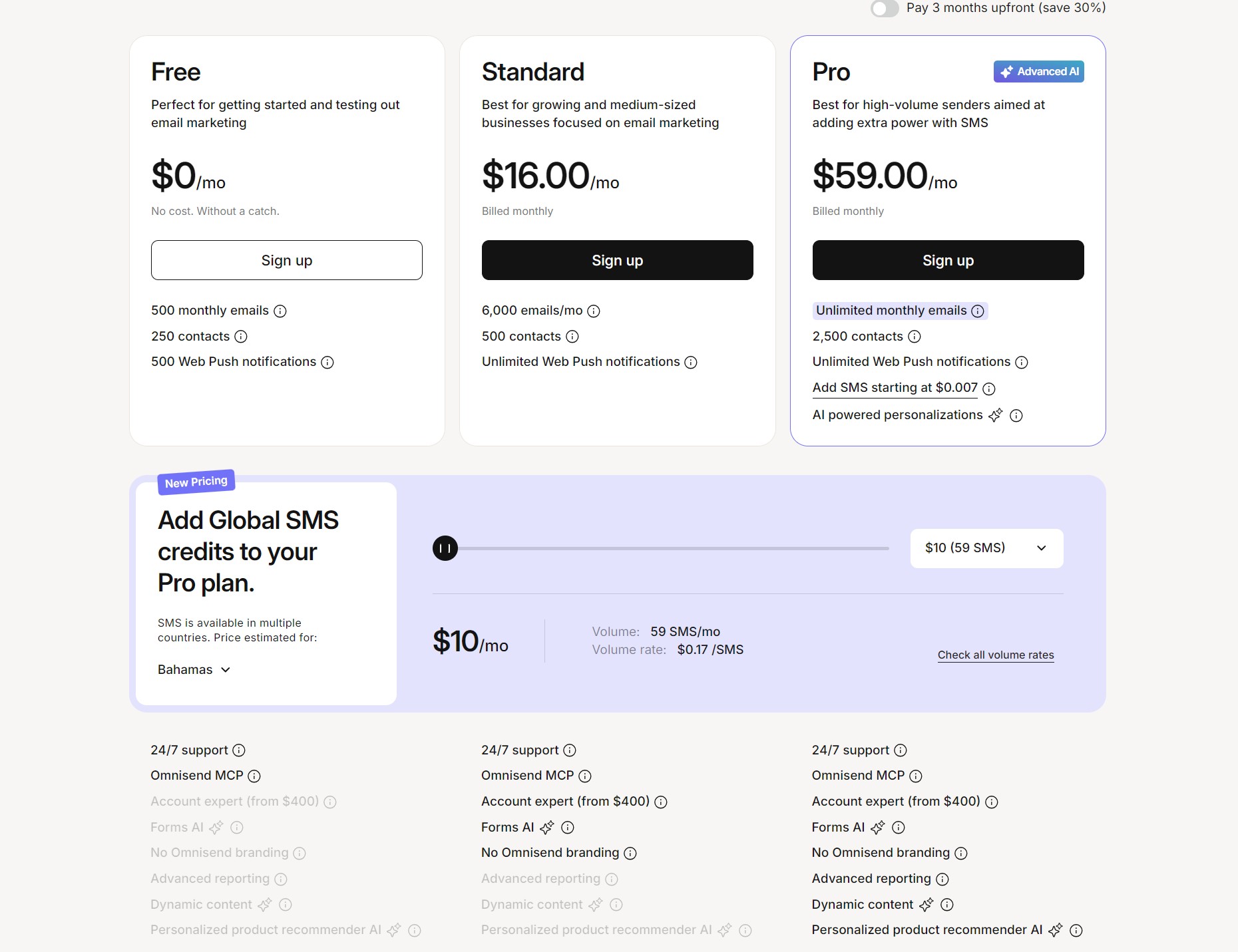
Omnisend uses volume-based SMS pricing with bundles. Bundles start at $10/month and are available at an additional cost to the Pro plan.
How to calculate SMS marketing ROI
Return on investment (ROI) is a key performance indicator (KPI) that measures the impact of SMS marketing. It shows how much revenue you generate compared to what you spend.
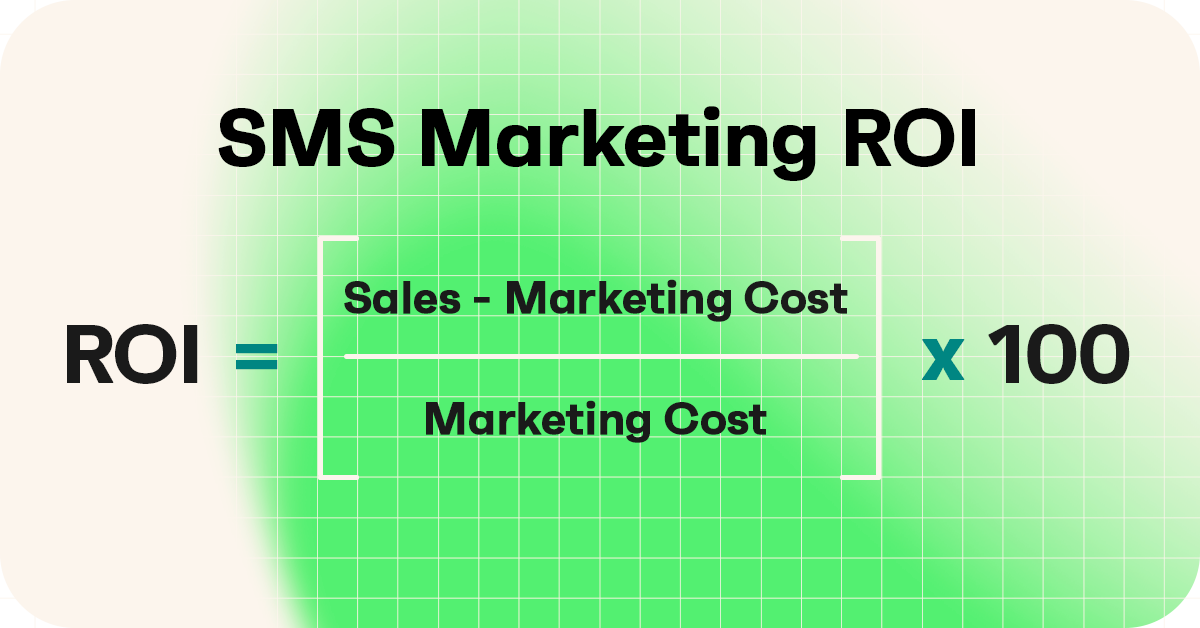
Here’s how to calculate your SMS marketing ROI:
ROI = (Revenue – Cost) ÷ Cost × 100
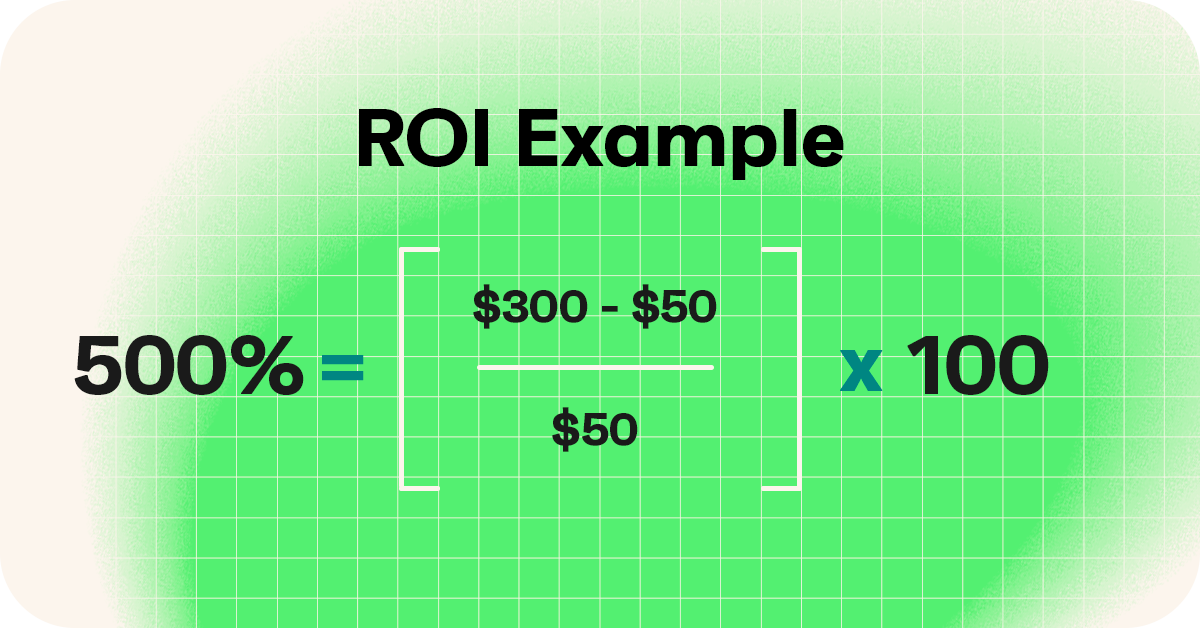
Say your SMS campaign makes $500 in sales. At current U.S. rates, reaching 1,000 contacts with a single-segment text costs $7 to $9, putting ROI north of 6,000%. For benchmarks across campaign types, see our SMS marketing ROI guide.
High ROI from SMS isn’t a theory, either. In 2025, automated SMS messages earned an average of $0.74 per send, compared to $0.15 for campaigns.
The channel works, but only if you implement it properly and track returns. Just remember, results won’t always look the same.
For example, promotional blasts might deliver 300% ROI, while abandoned cart recovery could hit 800% or more. Order confirmations, on the other hand, generate loyalty but minimal direct revenue.
The key is to track ROI individually for each campaign type to understand where to invest and where to pull back. Test, measure, and optimize based on your specific audience and offers.
How to choose the right SMS platform
Not every SMS provider will fit your brand’s needs. Use this checklist to evaluate how much SMS marketing is really worth from each provider:
- Deliverability rates: Messages must actually reach subscribers’ phones across carriers and regions, not get filtered or blocked
- Automation capabilities: Pre-built workflows for abandoned carts, welcome series, and post-purchase follow-ups save time
- Analytics and reporting: Track opens, clicks, conversion rates, and ROI at the campaign level
- Customer support: Fast and reliable help when campaigns need troubleshooting or compliance questions arise
- Integration options: Seamless connections to your ecommerce platform, CRM, and other tools
- Transparent pricing: No hidden fees, clear per-message rates, and straightforward credit systems
For ecommerce, omnichannel support is a big plus, letting you coordinate messaging across channels, so you can reach customers where they’re most responsive.
Omnisend’s Pro plan lets you build omnichannel flows containing SMS, email, and web push notifications, in addition to standalone SMS campaigns.
👉 Ready to see Omnisend in action? Sign up for the free plan and send your first SMS campaign today.
Quick sign up | No credit card required
FAQs
1. How much does SMS marketing cost?
On Omnisend, SMS is now an exclusive feature of the Pro Plan. For U.S./Canada recipients, pricing ranges from $0.007 to $0.009 per send with bundles starting at $10/month. That volume-based model offers lower per-message costs as your monthly SMS spend increases.
2. What factors influence texting costs?
Your costs vary by message length (160 characters for standard messages, 70 for Unicode), destination country, and volume. Going over character limits splits messages into multiple parts, with each charged separately.
3. Are there free SMS marketing platforms?
While some platforms offer free trials or limited free credits, sustainable SMS marketing requires paid services for ecommerce segments, flows, and reports. Look for low-cost credits and bundles instead of free options.
4. How can I reduce the cost of SMS marketing?
Keep messages within character limits to avoid splitting costs. Target engaged audiences, use automation for better conversion rates, and choose platforms offering bundled SMS credits with their subscription plans.
5. How many text messages should I send per month?
While there’s no fixed number, you can start with two to four messages monthly, plus automated flows like cart recovery. Test frequency based on your campaign goals and audience tolerance.
6. Can I do SMS marketing for free?
Not sustainably. Some providers offer free credits or trials. However, ongoing text message marketing typically requires paid plans or credit bundles to scale effectively.
7. Why did my SMS cost more than expected?
The most likely explanation is that your message exceeded 160 characters, included Unicode, or was sent to countries with higher carrier fees.
8. What’s the difference between SMS and MMS pricing?
MMS messages support media like images or GIFs, but they cost more per send. SMS is text-only and more affordable for most marketing use cases.