8 Best Text Messaging Services for Business Compared
A promising lead can disappear quickly when a call goes unanswered or a follow-up arrives too late. Texting gives businesses a fast, direct way to continue the conversation on the device customers already use every day. As of April 2026, 5.83 billion people—70.4% of the global population—use a mobile phone.
The best text messaging service for business helps your team communicate with leads, customers, and employees from a dedicated business number. Depending on the platform, you can manage two-way conversations, send bulk messages, schedule campaigns, automate reminders, and use templates for common customer interactions.
In this guide, we compare eight leading business texting services by features, pricing, integrations, and use case so you can find the right platform for keeping customers engaged and your team in sync.
8 Best Text Messaging Services at a Glance
Here’s a quick overview of the best text messaging services for SMS automation and bulk SMS marketing campaigns.
| Messaging app | Best for | Standout features | Pricing | Integrations |
|---|---|---|---|---|
| Nextiva | All businesses, particularly those in highly regulated industries like healthcare and finance | SMS reply suggestions based on customer personality insights | Starts at $15/month | 20+ native integrations with CRMs, help desks, and ERPs; 1,000+ integrations via Zapier |
| Textla | Budget-conscious small businesses with fluctuating messaging volumes | Automatic contact-list cleaning and credits that never expire | Starts at $25/month, plus $0.01 per SMS segment | No major native integrations; connects with 6,000+ apps via Zapier |
| EZ Texting | Non-tech SMBs | Image library and editor to design visuals for MMS | Starts at $25/month | 5 native integrations; others via Zapier |
| Twilio | Enterprises with developer resources | Programmable messaging APIs for full customization | Starts at $0.0083/SMS | 100+ platform and SaaS integrations (some are paid) |
| SimpleTexting | SMBs with franchises or branches | Automatic dead number removal from contact lists | Starts at $39/month | No native integrations; only via Zapier |
| Textedly | Retailers and e-commerce shops | Text-to-pay feature that sends secure payment links to customers | Starts at $29/month | No native integrations; only via Zapier |
| Podium | Enterprises requiring advanced AI features | Agentic AI that automates SMS conversations | Custom pricing | 50+ direct integrations; more via Zapier |
| Textmagic | Sole proprietorships using email and SMS | Email-to-text feature that lets you send and reply to SMS from your email tool | Starts at $0.049 per SMS | SMS Gateway API and Zapier |
We evaluated business texting platforms based on pricing, ease of use, two-way conversations, campaign tools, automation, integrations, compliance support, scalability, and customer reviews. We also considered which types of businesses each platform serves best.
Essential Business Texting App Features
Business texting services and text message marketing are a must for businesses, especially as 90% of SMS are opened within three minutes of being sent.
Keep in mind that business texting platforms fall into several categories. Some focus on promotional campaigns and bulk SMS messages, while others support ongoing customer conversations, integrate texting with business phone systems, or provide APIs for developers. The right option depends on whether you primarily need marketing, customer service, sales outreach, notifications, or custom messaging workflows.
Here are some must-have business texting service features that can help you connect with customers beyond just promo message blasts:
- Campaign management: Pick a platform that supports templates with dynamic fields like names or dates so you can personalize at scale. Even better if it lets you preview and schedule messages in advance.
- Multimedia messaging service (MMS): Images, GIFs, and short videos are great for engagement. Ensure the platform supports common file types and good-enough file size limits.
- Team and group texting: A shared inbox means all customer messages get answered. Features like permission settings, conversation assignment, and internal notes can also be helpful.
- Reporting and analytics: Prioritize a service that gives you detailed reporting on delivery rates, replies, clicks, and opt-outs so you can see what’s working and what’s not.
- Automated drip campaigns: A key tool for personalized SMS blasts, these campaigns send messages automatically based on timing, customer actions, or data points such as birthdays and sign-up dates. You can also improve results with advanced segmentation and A/B testing.
- Integration capabilities: Check if the platform comes with built-in integrations, support for connectors like Zapier or Make, and API access so you can sync SMS data with your CRM, ERP, and other business tools.
Finally, you must register your business phone number for Voice over Internet Protocol (VoIP) texting to comply with the Application-to-Person (A2P) 10DLC anti-spam regulations. This registration process can take 10–30 days, so be sure to plan ahead. Check out the video below to learn more about this process.
Top 8 Business Text Messaging Apps
There are dozens of business texting services out there — some offer all-in-one platforms with VoIP, video, and SMS messaging (like Nextiva), while others focus solely on text messaging.
To help you find the right fit, we’ve compared the top business text messaging apps so you can choose the best one for your communication goals.
1. Nextiva
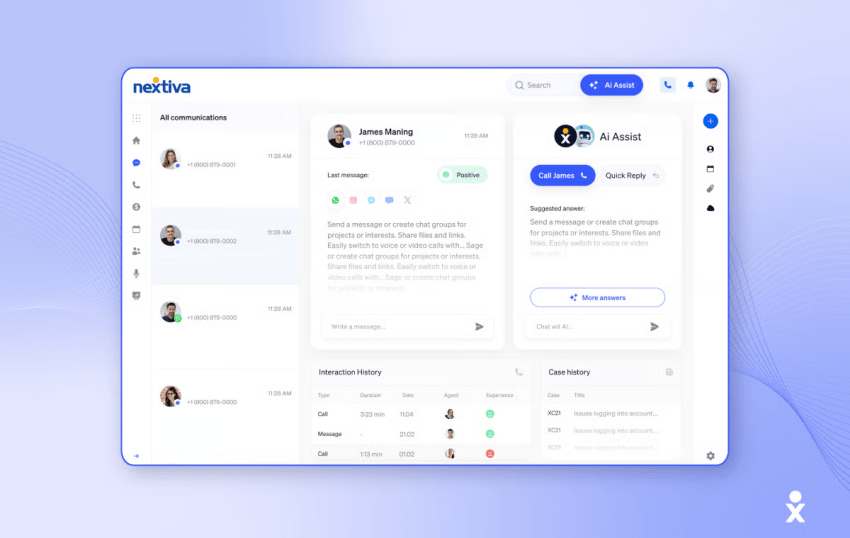
Nextiva is an all-in-one cloud communications platform that combines VoIP phone service, video meetings, team chat, CRM, and business text messaging software in a single, unified workspace. You can look at Nextiva’s messaging capabilities in two ways:
- Business SMS: Send and receive texts using your business VoIP number without signing up for a third-party SMS messaging provider.
- Message Pro: This is designed for teams and brings SMS into your shared workspace. Incoming messages go to the entire team, so any member can continue the conversation.
Nextiva gives you customer personality insights to guide tone, shared messaging templates for consistency, and a mini-CRM view with past message history for full context.
Nextiva comes with 20+ native integrations, and you can use connectors like Zapier or Nextiva’s APIs to build custom ones. It’s also fully compliant with industry standards from the Cellular Telecommunications Industry Association (CTIA), making it easy for businesses to follow SMS regulations.
Key features
- Unified messaging: Manage SMS, voice services, video, email, and team chat in one platform and with full context of previous customer conversations.
- Team-based SMS routing: Send incoming texts to a shared team inbox and route them to an agent’s queue based on their experience or workload.
- Business automation builder: Trigger actions like sending automated messages based on customer events or time-based rules.
- After-hours auto-replies: Set automated responses outside of business hours to let customers know your business is closed, when you’ll reopen, and when they can expect a reply.
- Automatic SMS notifications: Send automated text messages like appointment reminders, status updates, and surveys.
- Consent management: Use Nextiva’s built-in tools to capture consent, manage opt-outs, and enforce proper messaging practices.
- AI-powered redaction: Automatically hide personal information in call transcripts, screen recordings, and messages.
- Desktop and mobile app: Send and receive texts from your business number, and get real-time notifications on your phone, desktop, or browser with Nextiva’s apps.
Apart from these, you also benefit from Nextiva’s larger feature set, like trend reports, customer journey workflows, sentiment analysis, and AI-powered ticket routing.
Pros
- Allows you to send texts directly from your VoIP business number
- Combines SMS to customers and DMs to teammates on one platform to avoid tab switching
- Analyzes a customer’s historical data and personality to give reply suggestions
Cons
- Doesn’t support SMS short codes
- Doesn’t allow international SMS
Pricing
As a complete CX solution, Nextiva has a tiered pricing model that includes support for SMS service, VoIP, and multiple communication channels, with all plans supporting Nextiva SMS. The pricing plans are divided into two main categories:
Small business:
- Core: $15 per agent per month, billed annually
- Engage: $25 per agent per month, billed annually
- Scale: $75 per agent per month, billed annually
Enterprise:
- Essential: $75 per agent per month
- Professional: Custom pricing
- Premium: Custom pricing
SMBs with 1–100 employees also get a steep discount when signing a paid 12-month (or longer) agreement as a new customer.
Ratings and reviews
Many reviewers mention reliability, ease of use, and standout customer support for the favorable review.
Some also appreciate how it brings VoIP, SMS, email, and other channels into one platform. This aligns with the sentiment in the 2025 Nextiva CX Trends Report, where 81% of respondents said they wanted to consolidate their CX tools into one platform.

2. Textla
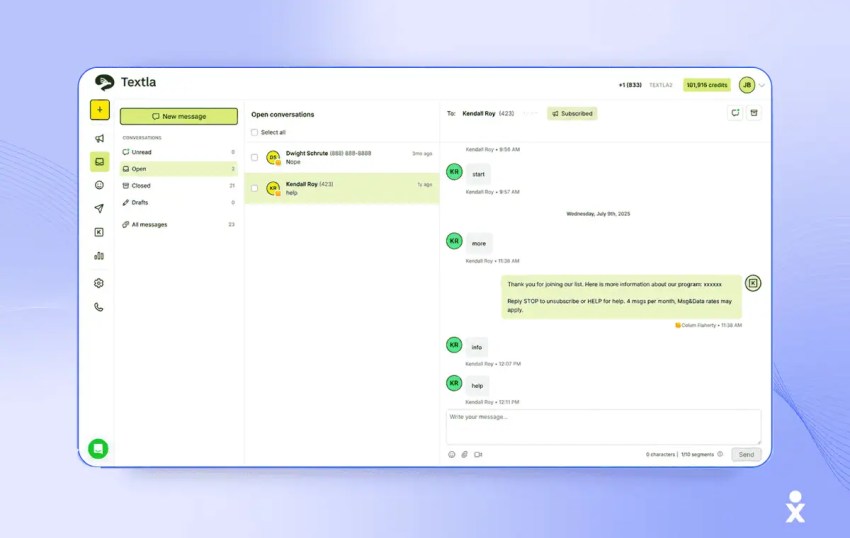
Textla is one of the most affordable text messaging services for small businesses, particularly if you want to send campaigns regularly without committing to a large bundle of monthly credits. Plans start at $25 per month, and SMS messages cost $0.01 per segment, with carrier fees included. Purchased credits don’t expire, so you don’t lose money during quieter months.
The platform covers the essentials, including bulk campaigns, two-way conversations, contact segmentation, MMS, keyword opt-ins, and real-time delivery reports. Its automatic list-cleaning tools also update invalid or unreachable numbers, helping you avoid spending credits on contacts who can’t receive your messages.
Textla is best suited to small businesses that prioritize affordability and ease of use over advanced automation or extensive native integrations.
Key features
- Bulk and direct messaging: Send mass campaigns or respond to individual customers through a shared inbox.
- Contact list segmentation: Import contacts through CSV files and organize them using groups and tags.
- Automatic list cleaning: Keep contact list current by flagging invalid, unreachable, or opted-out numbers.
- Real-time analytics: Track message delivery and view error codes explaining why individual texts failed.
Pros
- Includes unlimited contacts and bulk campaigns on the entry-level plan
- Provides a shared inbox for managing customer conversations
- Credits never expire, making it suitable for businesses with fluctuating messaging volumes
Cons
- Subscription fees don’t include message credits, which must be purchased separately
- Scheduled campaigns, recurring messages, keyword opt-ins, and personalization require the Professional plan
- Doesn’t currently offer a mobile app
Pricing
Textla offers three pricing plans:
- Starter: $25 per month, or $19 per month billed annually
- Professional: $50 per month, or $39 per month billed annually
- Enterprise: Custom pricing
The subscription provides access to the platform but doesn’t include messaging credits. U.S. SMS messages cost $0.01 per incoming or outgoing segment, while MMS messages cost $0.03. Longer SMS text messages may use multiple segments (typical segments are 160 characters), and emojis can reduce the number of characters included in each segment.
Textla also offers a 14-day free trial with 100 credits.
Ratings and reviews
G2 reviewers frequently praise Textla’s affordability, simple interface, quick setup, and responsive support. Although its Trustpilot rating is considerably lower, this is based on only five reviews (three 5-star reviews and two 1-star reviews, one of which was identified as a scammer) and may not be representative.
3. EZ Texting
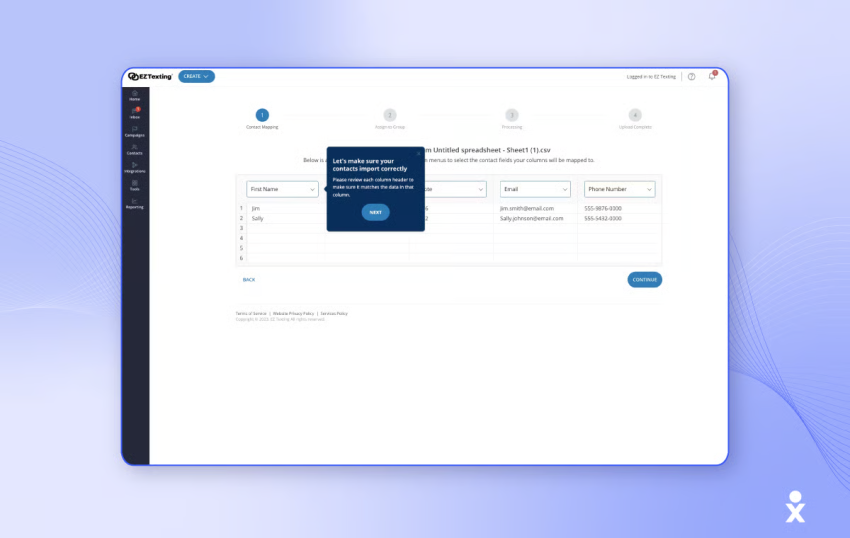
As the name suggests, EZ Texting is designed for non-tech businesses that want to explore SMS marketing services without being intimidated by complex features and workflows. For example, you get a ready-to-use local number so you can start immediately and don’t have to go through the 10DLC process.
The UI is mostly intuitive, and you get detailed getting-started docs and even onboarding support on the higher plans. While you can do most things, including SMS blasts, two-way texting, and drip campaigns, the features tend to be less advanced.
It comes with out-of-the-box integrations for Mailchimp, HubSpot, Squarespace, Shutterstock, and Constant Contact. You can use Zapier to connect to other tools.
Key features
- Automations: Send automated reminders and gather customer feedback via SMS polls.
- Advanced triggers: Automate sequences and trigger SMSes based on keywords or events.
- AI-assisted messaging: Use AI to generate message drafts quickly, making SMS campaign creation easier.
- Contact segmentation: Organize your contacts into groups for targeted messaging.
Pros
- Comes with a built-in image library and editor for MMS
- Each account includes a local textable number so you can start immediately
- Allows you to forward calls to the local number to your VoIP
Cons
- Provides only an iOS app; Android users will have to use the mobile browser
- The parent-child setup lacks a unified view, and credits sent to child accounts cannot be reversed
- Features like short code are only available on the Enterprise plan
Pricing
EZ Texting offers four pricing plans:
- Launch: $25 per month, billed monthly
- Boost: $75 per month, billed monthly
- Scale: $125 per month, billed monthly
- Enterprise: $3,000 per month, billed monthly
It also provides a 14-day free trial (you can only text your phone number) and a 20% discount on annual subscriptions.
Ratings and reviews
Much praise comes for EZ Texting’s user-friendly interface. Some reviews also mention that its simplicity can be limiting, especially when it comes to advanced features, like text message automation.
4. Twilio
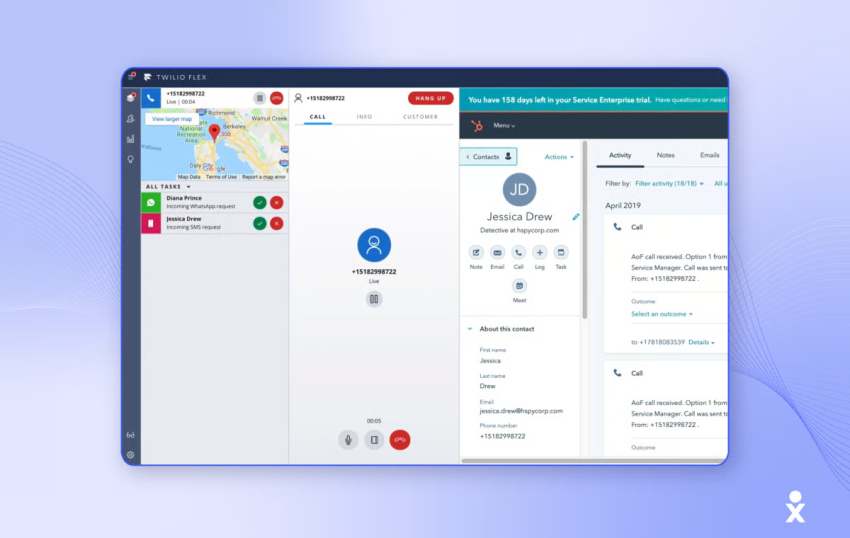
Twilio’s SMS marketing solutions aren’t plug-and-play. You use its programmable APIs to create your own Communications Platform as a Service (CPaaS) setup — they provide the backend infrastructure, and you build the logic and user interface. While Twilio has introduced no-code tools like Twilio Studio and Flex, you’ll still need some tech familiarity to use them.
This makes it best for teams with developer resources or businesses with complex contact center workflows.
Key features
- Omnichannel messaging: Set up unified two-way messaging across the SMS platform, WhatsApp, live chat, and more.
- Custom logic: Build custom messaging logic using Twilio’s programmable messaging API.
- Delivery tracking: Track the status of outbound messages with callback endpoints and URLs.
Pros
- Reliable at scale, especially for handling high-volume enterprise communications
- Local sender IDs and compliance tools allow you to reach customers in 180+ countries
- Provides code snippets, SDKs, and more to help you get started quickly
Cons
- Implementation takes much longer than other tools on this list
- You’re responsible for building the frontend and maintaining your app, which can be risky
- Costs can add up, especially if you’re using its no-code or automation tools
Pricing
Twilio has a usage-based pricing model, where costs vary based on the type of message (SMS vs. MMS, inbound vs. outbound) and the phone number used (short code, long code, or toll-free). It starts at $0.0083 per inbound or outbound SMS on a local number and can go up to $0.022 for an outbound MMS via a short code.
Two things to consider:
- Texts are billed per segment, not per message, and those longer than 160 characters are split into segments.
- You’ll be charged $0.001 for messages that end in a “Failed” status.
Twilio’s no-code tools, like Studio or Flex, have their own pricing, separate from text message costs.
Ratings and reviews
Feedback on G2 is mixed. Users like how flexible it is, but many say it’s not easy to set up and takes time to get everything working, as support is slow. Trustpilot scores are significantly lower, with many reviewers saying they’re frustrated with Twilio’s customer support.
5. SimpleTexting
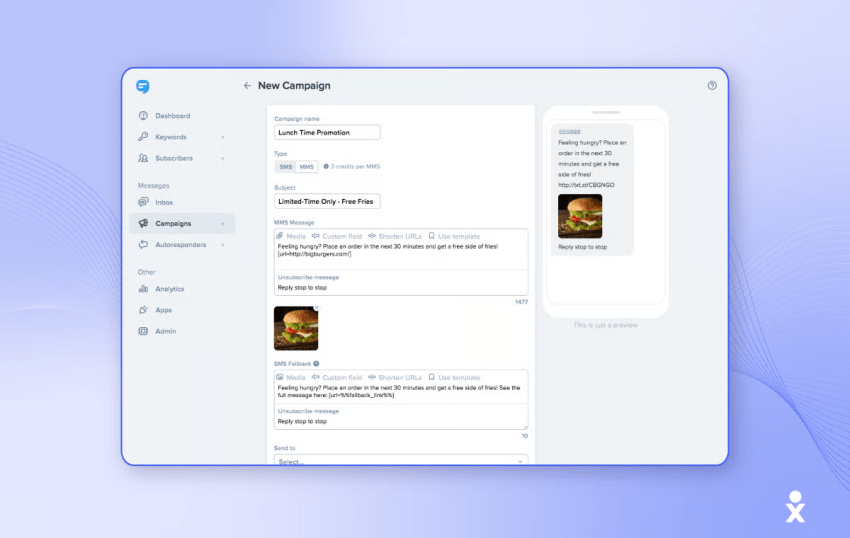
SimpleTexting is an SMS marketing software that’s built for non-tech users, especially teams at mid-sized enterprises. You get quite a few advanced features, and they also build custom integrations on request and for an additional fee.
While SimpleTexting does support agencies and franchises, the costs can add up quickly. You’ll pay $20 per month for each additional user and $10 per month for every extra phone number.
There are also no native integrations. You’ll have to build your own with Zapier.
Key features
- Timed auto-responders: Set auto-responders with delivery windows so your contacts aren’t disturbed at the wrong time, like on weekends.
- Segmentation: Group subscribers based on behavior or demographics for targeted campaigns.
- Capture forms: Build forms to collect subscribers and get opt-ins from your site or social media.
- SMS polling: Collect feedback or opinions using SMS polls and text-to-vote campaigns.
Pros
- Detects and removes dead numbers automatically
- You can use tags to filter messages to different campaigns
- You can send files via SMS — it’ll be shared as a hyperlink
Cons
- Schedule messages in batches, which can lead to delays
- Supports only plain text
- Pricing can be complicated as it involves credits and add-ons
Pricing
SimpleTexting uses a credit-based pricing model with all features available to everyone. It starts at $39 per month (plus a $4 one-time carrier registration fee) for 500 credits and a local number, which typically covers 500 SMS messages. Outgoing MMS messages cost three credits each, and incoming MMS costs one credit. Any unused credits roll over to the next month.
You can also add team members for $20 per month per user and extra numbers for $10 per month each. Nonprofits, churches, and other tax-exempt groups get 15% off any monthly plan.
They offer a 14-day free trial, no credit card required.
Ratings and reviews
Most reviewers say it’s easy to set up and use, though some mention that the app can be a bit unstable at times.
6. Textedly
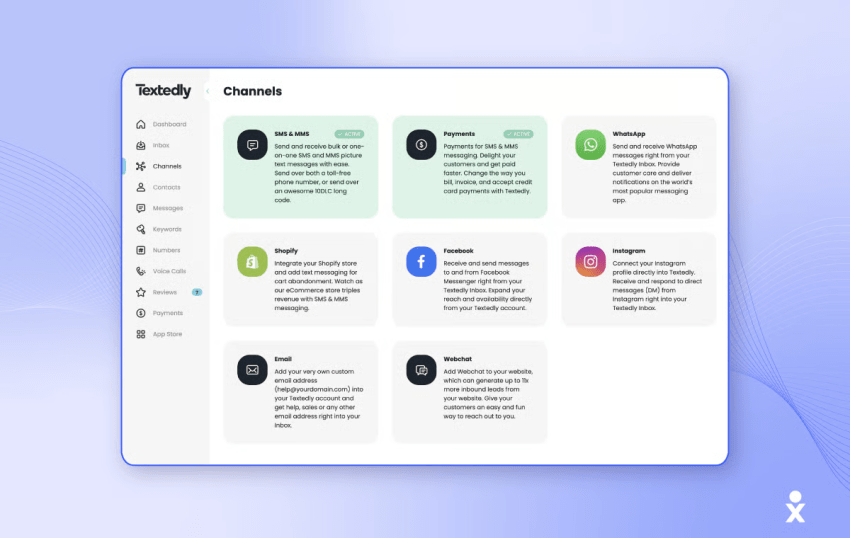
Textedly is best for retailers and e-commerce businesses that use SMS marketing services as one of the primary channels because you get high-utility features like Text-to-Pay and SMS review requests, along with core capabilities like mass text messaging, omnichannel inbox, and automation.
However, it focuses more on action than analysis, offering only basic metrics without advanced visualizations. There are also no native integrations.
Textedly only supports subscriber-based triggers and actions. There are no message or campaign-based triggers. This means you can’t perform actions like posting incoming text messages on Slack.
Key features
- Payment links: Send customers a secure link that they can click to make payments.
- Lead capture forms: Use webforms to build your contact list and get opt-ins.
- AI assistance: Use the AI Agent Assist features to draft messages and tweak replies.
- Review request links: Text customers a review link that they can click to leave a Google Business review.
- Team inbox: Use the shared inbox to route SMS messages to team members and conduct internal discussions via sticky notes.
Pros
- Supports rich text formatting for SMS
- Gives you a 300-character limit for SMS, making it easier to add Unicode symbols that take up more space
- Pricing plans come with a toll-free and 10DLC number
Cons
- You can’t move phone or web conversations to text
- Not HIPAA compliant by default. You’ll need to sign a Business Associate Agreement (BAA)
- You have to pay $10 for a new keyword, which can make campaigns like text-to-win expensive
Pricing
Textedly offers 15 paid pricing plans, starting $29 per month for 500 text messages and one keyword, up to $5,520 per month for 3000,000 text messages and 50 keywords. Annual plans come with a 20% discount.
You can purchase extra texts and keywords as add-ons: $30 for an additional 500 texts and $10 per additional keyword.
They offer a 14-day free trial.
Ratings and reviews
Textedly is well-rated for features like bulk SMS and two-way messaging, while tools like reporting, team management, and text-to-landline see lower numbers. However, some users mention disappointment with the customer service, stating unfulfilled promises and difficulties canceling their subscriptions.
7. Podium
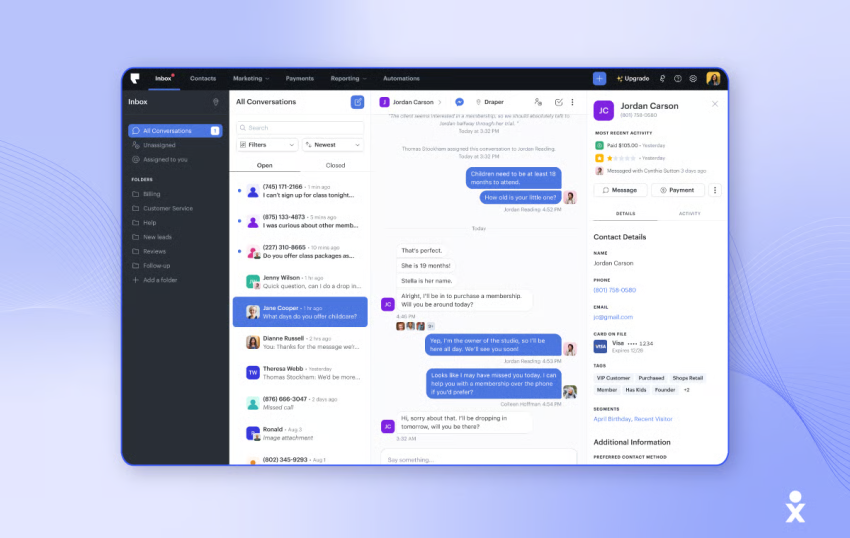
Podium is an AI-powered customer communications platform that supports phone, SMS, and social messaging. These channels are tightly integrated with its AI agent, which can reply to messages, qualify leads, and handle FAQs automatically.
You also benefit from its marketing features like funnel-based lead tracking, automated drip campaigns, and contact profiles. Where it falters is in reporting: you get inbox reports and even lead reports, but they’re scattered.
While Podium offers 50+ integrations and Zapier support, most are geared toward invoicing and general CX, not SMS-specific tasks like opt-ins/opt-outs, delivery reports, or message events.
Key features
- Unified CRM: Consolidate leads from texts, calls, forms, and email into one central CRM.
- AI assistance: Provide instant answers, respond to reviews, and summarize phone calls automatically with AI.
- Automations: Set up custom automated workflows triggered by actions like events or status changes.
- Link shortening: Use Podium’s approved domain, Podium.com, for link shortening so carriers don’t block your message.
Pros
- Get alerts when automations fail or decline in performance
- Agentic AI can auto-reply to customer SMS messages
- You can purchase one-time bulk messaging credits during seasonal demand
Cons
- While messages go to agents via the round robin method, their workload isn’t considered
- No automated QA features; you’ll have to manually review the AI agent’s responses and provide feedback
- MMS can get pricey at 3 credits for the U.S., 5 credits for Canada, and 15 credits for Australia
Pricing
Podium has three plans, but pricing is quote-based, so you’ll need to contact their sales team for the exact rate. Also, the phone systems and AI agents are add-ons and not included in the base plans.
Ratings and reviews
On G2, Podium scores highly for its core SMS features, while its AI agent, integrated with SMS, lags slightly behind at around 65%–70%. Most reviewers on Trustpilot mention disappointment with the AI agent features and the need for better customer service.
8. Textmagic
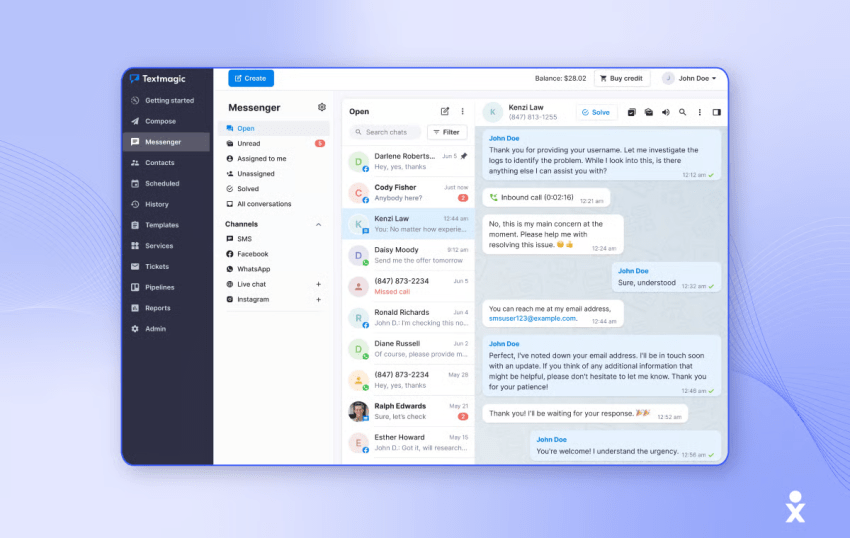
Textmagic is one of the best business texting systems for small teams that prefer managing SMS through email instead of a separate tool. It’s simple with an uncluttered UI and has a variety of features like omnichannel widgets, voice, AI assistance for agents, and task management.
However, its focus on simplicity and broad functionality means it offers little depth, so some advanced features like automation and reporting are pretty basic. You’ll need to build advanced features like callback URLs and Unicode messages using its SMS Gateway API.
Integrations are only supported via Zapier, and while the triggers here are limited, you have plenty of options for actions.
Key features
- Email-to-SMS: Have one-on-one conversations or send group texts from your email by sending it to {phonenumber}@textmagic.com and receive their replies in your inbox as well.
- Templates: Personalize templated messages with mail merge and dynamic fields for quick responses and recurring messages.
- Number validation tools: Check number validity and carrier info through bulk imports or API integration.
- Task management: Create and categorize tasks to prioritize conversations and track customer issues.
Pros
- Automatically filters out landline numbers from your list of contacts, so you only send texts to mobile numbers
- Lets you schedule SMS messages from inside email provider apps like Gmail and Outlook
- Customers in the U.K. and Australia get a free sender ID
Cons
- Unlike some other tools, it doesn’t let you connect a landline number to the platform for sending SMS
- Doesn’t support cross-border texting
- There can only be one active SMS survey on a number
Pricing
Textmagic uses a credit-based pricing model. Outbound SMS costs $0.049 per message, MMS costs $0.08 per message, and email marketing campaigns cost $0.006 per email.
Phone numbers (local or toll-free) are $10 per month, and the 10DLC registration is also $10 per month, though both are free for the first month.
Services like carrier/email lookup cost $0.04 per query, and voice calling starts at $0.041 per minute for outbound and $0.023 per minute for inbound. Textmagic doesn’t charge separately for social messaging, the email help desk, or task management.
Ratings and reviews
Users highlight Textmagic’s easy setup and helpful automation tools, while some point out usability quirks in the inbox and reports. Some also praise its email-to-SMS features.
Business Text Messaging Campaigns and SMS Marketing Use Cases
Traditionally, e-commerce businesses have used SMS marketing platforms for text blast services to inform readers about discounts or sales.
But business text messaging campaigns are not limited to e-commerce. Companies in all industries, from tech to healthcare, can benefit from using automated texting software to communicate with customers and employees.
Uses for business text messaging
Beyond digital SMS marketing campaigns, some practical use cases for using business texting platforms include:
- Meeting confirmations and contact information: Send a text message to confirm a meeting time, location, and any necessary contact information.
- Personal thank you messages: Send a personal thank you message to a customer after they purchase or complete a service. These can be set up with autoresponders to ensure each customer receives the same experience.
- Team/group texting: Use group texting to communicate with your team members quickly and efficiently.
- Product/order updates: Send follow-ups and updates on a customer’s order or product delivery status. Your customers will appreciate this — in fact, 56% of customers say they don’t mind sharing their information for better service.
- Sending gift cards: Companies can use gift cards to thank customers or offer them as promotional offers. This is quite relevant at the moment, as 79% of consumers surveyed by McKinsey mention they’re reducing spending and are on the lookout for discounts.
- Two-factor authentication: Use text messaging as part of a two-factor authentication process to enhance security.
- Customer job-site photos: Send photos of a job site to customers to keep them informed about progress. This can be particularly effective, as 79% of consumers prefer personalized experiences over personalized messages.
- Appointment reminders: Send appointment reminders to customers to reduce no-shows. According to SolutionReach, this can save practices up to $5,000 per year per staff member who would otherwise spend time calling patients manually.
- Customer event and community invites: Invite customers to events or community activities via text message. If you’re using A2P messaging for this, make sure your campaigns are registered with The Campaign Registry to stay compliant and avoid message filtering.
- Customer satisfaction surveys: Send chat-based SMS surveys to collect feedback and measure customer satisfaction (CSAT). This helps maintain a personal touch, ensures immediate responses to inquiries, and improves overall customer outcomes.
These are just a few examples of how businesses can use text messaging effectively. The key is to think creatively and find ways to use text messaging that will benefit your business and your customers.
What to Look for in a Business SMS Provider
When choosing a business SMS service, it’s important to consider the features and functions that align with business requirements. Below are some essential attributes to watch for:
- Virtual phone numbers: A virtual phone number enables you to send and receive texts via a local or toll-free line. They are ideal for businesses keen on sustaining a local image or offering clients a toll-free way to reach out.
- Team messaging: Team-based collaboration facilitates several users to send and receive SMS from a collective inbox, which is ideal for firms looking to encourage team members to support customers and prospects via SMS or MMS.
- Toll-free texting support: Texting customers from a toll-free business phone number lets customers intuitively call your sales or support line, who prefer discussing matters verbally.
- Generous text message volumes: A valuable service will grant a generous quota of messages, for instance, 1,000 texts for each user every month, catering to businesses with extensive texting needs.
- Desktop functionality: This feature facilitates exchanging texts from your PC, which is ideal for businesses whose teams prefer desktop-based communication.
- Mobile functionality: A smartphone app is a must if you want to exchange business text messages through mobile or tablet devices, befitting businesses aiming for flexibility and mobility in communication.
In addition to these critical features, excellent customer support, pricing, and positive customer reviews are vital to consider before settling on a business text messaging app for your company.
Business SMS Compliance Checklist
Before implementing text messaging into your business protocols, you must ensure you do so in a way that complies with industry best practices and legal requirements.
Business text messaging is highly effective. It’s also highly regulated, and if you fail to comply with global SMS marketing laws, you can be fined thousands of dollars. You also lose customer trust, and chances are high that you’ll be blocklisted by carriers.
For instance, Telstra was fined $396,714 for making people share personal info just to unsubscribe from texts. In the U.S., each noncompliant text can trigger a fine of $500–$1,500 under the Telephone Consumer Protection Act (TCPA) — and that’s per message, not per campaign.
Phone companies and governments have collectively established benchmarks for unsolicited phone calls and text messaging. In North America, the CTIA and the FCC’s TCPA regulate message content, frequency, and dispatch.
Here’s a general checklist for complying with legal requirements, CTIA guidelines, and carrier policies:
- Get explicit opt-in: Obtain consent specifically for SMS communications and keep a record of when and how each person opted in. Clearly state which business will send the messages, what recipients can expect, and how frequently they may receive texts. Consider separate opt-ins for campaigns with different purposes.
- Register your sending number: Businesses sending application-to-person messages from standard U.S. 10-digit numbers generally need to complete A2P 10DLC brand and campaign registration. Toll-free numbers follow a separate verification process. Check whether your provider manages registration and related fees.
- Provide clear opt-out instructions: Every text sent out should have straightforward directions for recipients who want to discontinue the service—for example, “Reply STOP to unsubscribe.” Your system should also recognize and honor reasonable opt-out requests expressed in ordinary language.
- Honor do-not-contact (DNC) lists: Update suppression lists promptly so scheduled or automated messages aren’t sent to people who have withdrawn consent or opted out.
- Respect quiet hours: Avoid sending marketing texts before 8 a.m. or after 9 p.m. in the recipient’s local time zone. State laws may impose stricter limits, so follow the requirements that apply to each recipient.
- Follow applicable privacy laws: Protect the customer data collected through your texting program and comply with relevant privacy and security requirements. These may include state privacy laws, the GDPR when processing covered EU personal data, or HIPAA when handling protected health information as a covered entity or business associate.
By following these legal and industry requirements, you can ensure you’re using text messaging responsibly.
Nextiva’s Business Texting Solution
Adopting a text messaging service for business is essential for customer engagement and streamlined communication today. The right tool enhances customer support and drives sales. Nextiva is a proven leader in unified customer experience management, and business text messaging is no exception.
Among the many options available, Nextiva stands out as a top solution. It offers unparalleled reliability and enterprise-grade communication features, such as SMS, voice, video, social media, and live chat. As a cloud communications leader, Nextiva can help businesses enhance their messaging strategy, deliver a superior customer experience, and boost sales.
Customers love businesses that text.
Talk with prospects and customers the way they prefer across every channel, including SMS/MMS.
Business Text Messaging FAQs
Nextiva is the best overall option for businesses that want texting integrated with phone, video, and customer communication tools. Textla is a strong alternative for budget-conscious small businesses because it offers low per-message pricing and unlimited contacts, while Twilio is better for developers that need a customizable SMS API gateway.
No, text blasting is legal when recipients have consented to receive the messages and the sender follows applicable opt-out, timing, identification, and recordkeeping requirements. Businesses should never send promotional SMS campaigns to purchased lists or people who haven’t opted in. Under the TCPA, certain automated marketing texts require prior express written consent.
Most reputable texting platforms for business don’t offer a permanently free plan because phone numbers, carrier fees, and message delivery all carry costs. However, Textla provides a 14-day trial with 100 credits, while SimpleTexting offers a free trial that lets you test messages using your own number. These trials are useful for evaluating an SMS marketing tool, but businesses generally need a paid plan to contact customers regularly.
Yes, you can add SMS text messaging to your VoIP phones. The best business texting services offer integration with VoIP phone service, allowing you to send and receive text messages using your existing phone number. This integration enables you to streamline business communications by using a single platform for both voice and text, enhancing customer interactions and improving operational efficiency.
The Federal Trade Commission has strict guidelines and penalties for businesses that spam customers with unwanted text messages. Messages and numbers marked as “spammy” also often get blocked or filtered, so before sending a text message, we recommend asking yourself, “Would I mind receiving this?”
10DLC, or 10-Digit Long Code, is a messaging system designed for businesses to send SMS messages using a local phone number. This system allows companies to communicate with customers more effectively by providing a recognizable and trustworthy number, enhancing customer engagement, and message deliverability.
Unlike short codes, typically used for mass messaging, 10DLC offers a cost-effective solution for businesses that need to send personalized messages. It supports higher message volumes than traditional long codes and complies with carrier regulations, ensuring that messages are delivered reliably and securely.
Yes, there are several free text messaging apps for businesses, such as Google Voice, TextNow, and TextFree. However, these services have limitations on the number of messages you can send, deliverability issues, and are restrictive in the features they offer. Most importantly, these free text numbers are often reassigned and are blocked from text message verification services.
Free texting services often come with limitations. Many providers offer free trial periods or basic plans that include a limited number of monthly messages. These options can benefit startups exploring SMS marketing without a financial commitment. However, free plans may lack advanced features like automation, integrations, and analytics, which are crucial for scaling communication efforts.
The terms text messaging and SMS messaging are often used interchangeably, but they are different:
– SMS, which stands for “Short Message Service,” is the most basic form of text messaging, allowing users to send plain text messages.
– Texting is a broader category that includes SMS and MMS messages, as well as internet-based messaging with enhanced features.