Is Free Website Hosting Worth It for Business?
Two unrelated products are sold under the name free website hosting. A free Wix or WordPress.com site is published on the vendor’s subdomain and displays the vendor’s ads. A free Cloudflare Pages site is published on a domain the business owns and injects nothing.
Only the second of those is defensible for a business, and only for a narrow set of sites. The question stays open for a brochure site that takes no payments and stores no customer data. Everything else runs into the terms, the address or the missing email.
What You Get on a Free Hosting Plan

Hosted site builders supply an editor and retain the platform. Developer platforms serve files built elsewhere and retain almost nothing. Domains, ads, email, support and the cost of leaving all fall along that line.

| Free site builders | Free developer platforms | |
| Examples | Wix, WordPress.com | Cloudflare Pages, GitHub Pages, Netlify, Render |
| Custom domain | Behind an upgrade | Included, with free SSL |
| Ads on published pages | The vendor’s | None |
| Email at the business domain | Sold as a separate product | Not offered at all |
| Support | Paid upgrade | Community forums |
Can You Use Your Own Domain?
A custom domain costs nothing on the developer platforms. Cloudflare Pages allows 100 custom domains per project, GitHub Pages issues free HTTPS on a custom domain, and Netlify Free and Render Free both include managed certificates.
On a hosted builder the same capability begins at the first paid tier. WordPress.com’s free domain for a year starts at the Personal plan. Until that upgrade the site is published at yoursite.wordpress.com or at a wixsite.com address, and anything linking to the business points there.
Do Free Hosts Put Ads on Your Site?
Free WordPress.com sites display WordPress.com ads to visitors. Turning them off requires the Personal plan. Wix bundles a custom domain, ad removal, payments and priority support into one upgrade. The same purchase settles the ad question and the address.
Nothing is appended to the page on Cloudflare Pages, GitHub Pages, Netlify or Render. InfinityFree markets the absence of ads as its main differentiator against the builder model. On the platforms that do inject, the objection goes past appearance. The business selects no advertiser, receives no share of the revenue and cannot keep a competitor out of the space beside its own prices.
Email at Your Own Domain on a Free Plan
No mainstream free tier includes mailbox hosting at a domain the business owns. GitHub Pages, Cloudflare Pages, Netlify Free, Vercel Hobby and Render Free are web-serving products with no mail service attached. Wix and WordPress.com both sell business email as a separate product outside the free plan.
Render extends the restriction to outbound mail. Free web services there cannot reach ports 25, 465 or 587, and transactional mail from the application fails at the network layer.
Mail at the business domain remains available by pointing MX records at a separate provider, and that is the normal arrangement even on paid hosting. The extra administrative work turns one hosting decision into two vendors and two sets of DNS records that have to stay in step.
What Support You Get on a Free Plan
Support on a free plan is a community forum. GitHub is the most candid about what that means in practice. Its stated response to a Pages site that outgrows the limits is a polite email from GitHub Support suggesting ways to reduce the site’s impact on its servers, including moving to a different hosting service that might better fit your needs.
Uptime commitments are not part of a free plan either. Netlify’s 99.99% figure appears only on Enterprise plans, and Wix sells premium support as an upgrade feature.
Is Cloudflare Pages Good Enough for a Business Website?

Cloudflare Pages is adequate for a static brochure site on a domain the business already owns. Builds are capped at 500 a month, files at 20,000 per site, single assets at 25 MiB and custom domains at 100 per project. None of those limits are reachable by that kind of site. Neither a bandwidth cap nor a request cap for static assets appears anywhere on the page.
Neither the Pages documentation nor Cloudflare’s Application Services terms contain a commercial-use prohibition, and that absence separates Pages from both GitHub Pages and Vercel Hobby. The only restriction in force concerns content type. Cloudflare’s Service-Specific Terms require paid products for serving video and reserve the right to limit accounts using the free CDN to serve a disproportionate share of pictures, audio or other large files. A text-and-images site for a law firm or a restaurant is inside those terms.
Mailbox hosting, a database and an uptime commitment are all absent from the tier. Support is the community forum, and server-side code running through Pages Functions counts against a separate Workers quota. None of that costs anything on the kind of site the tier is aimed at. A small-business brochure site serving 1,000 to 2,000 views a month runs on Pages for nothing.
Cloudflare gives a different reason for keeping the tier than most vendors do. Most free tiers exist to convert free users into paying ones, and tightening the limits follows from that purpose. Cloudflare’s stated position is that early free customers gave it the traffic volume its bandwidth pricing needed. A wide spread of free customers still helps convince regional telecoms to peer locally. That peering lowers the cost of the bandwidth paying customers use. On that accounting a broad free base pays for itself.
Commercial Use Rules on Free Hosting Plans
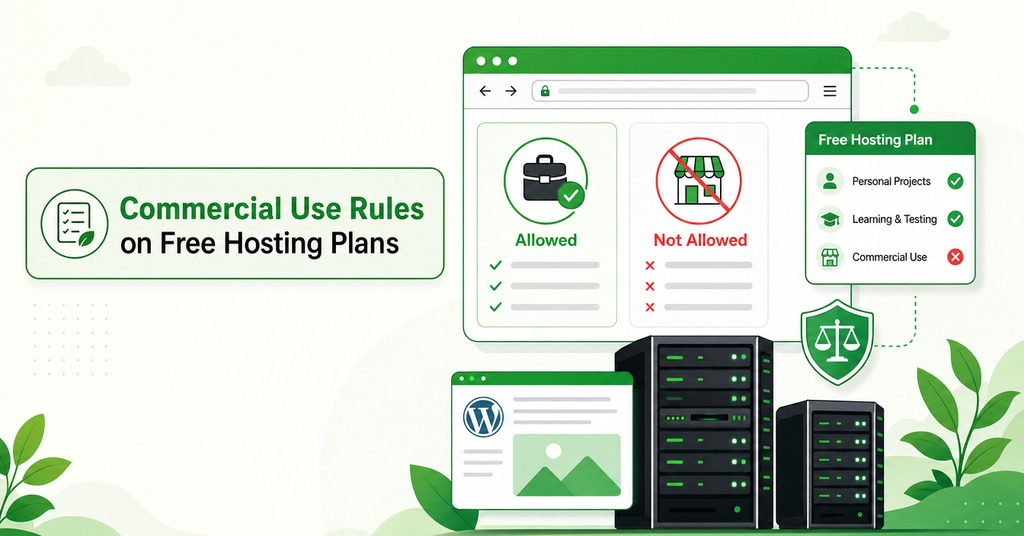
GitHub’s usage limits page bars Pages from operating as a free web-hosting service for an online business, an e-commerce site, or any website primarily directed at facilitating commercial transactions, and it warns against sensitive transactions such as sending passwords or credit card numbers. A site whose purpose is selling falls inside the prohibition. A purely informational business page is left unresolved by that wording. A public repository is a further condition of the free tier and leaves the source readable by anyone.
Vercel is stricter and states the test outright. Its Fair Use Guidelines restrict Hobby teams to non-commercial personal use only. Commercial usage is defined to cover advertising the sale of a product or service, receiving payment to build or host the site, and carrying advertisements. Read against a small-business site, the first clause describes nearly every brochure page in existence, and the second makes a site a freelancer was paid to build commercial before it takes a single payment.
Vercel notifies an account before it suspends one, and notification of outlier usage is the only warning the terms describe. Two structural limits apply well before any of that. Hobby teams cannot connect to Git repositories owned by an organization, and organization ownership is the normal arrangement as soon as more than one person touches the code. Runtime logs are kept for one hour against a day on Pro. Nothing is left to inspect when a fault is reported a day after it happened.
No payment capability exists on the Wix free plan, and the commercial-use question therefore never arises there. InfinityFree’s terms are the ones most often misquoted. They prohibit reselling or providing the services for a commercial purpose without written consent. The prohibition covers reselling the hosting itself, and InfinityFree’s own homepage invites clubs, community groups and small businesses onto the platform.
What Free Website Hosting Costs You
No credible study shows that Google penalizes a site for being on a free host. The costs that do exist are mechanical and documented on the vendors’ own pages.
A Vendor Subdomain Is Not Your Asset
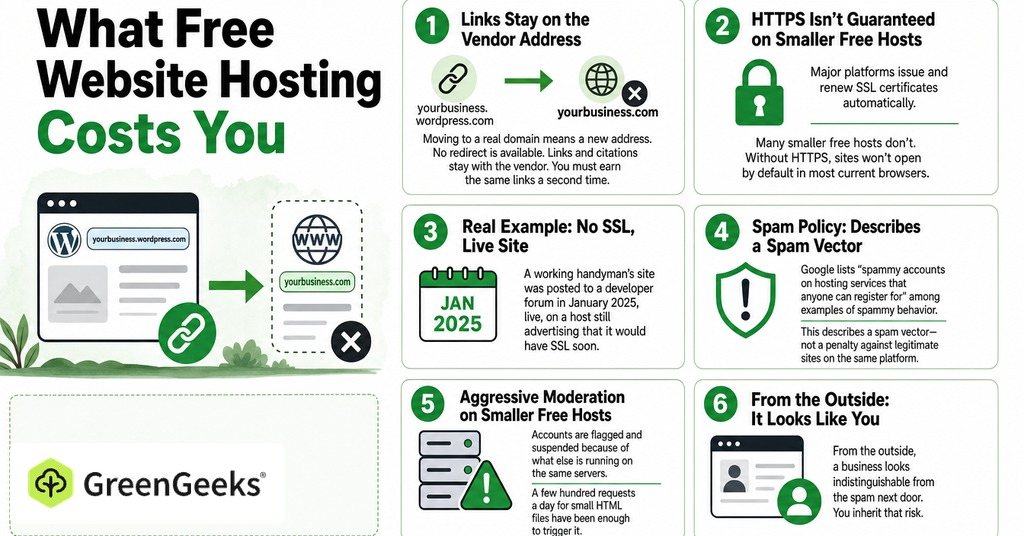
Inbound links and citations that accumulate on a yourbusiness.wordpress.com address stay with that address. The consequence becomes visible at the upgrade step. Moving to a real domain means moving to a new address and starting the link profile again.
Because the subdomain was never the business’s to redirect, no redirect is available. Whatever a directory listing, a supplier page or a local news write-up pointed at stays pointed at the vendor. The only remedy is earning the same links a second time.
Free Hosting and HTTPS in 2026
Certificates are issued automatically across the mainstream free platforms. Cloudflare Pages, GitHub Pages, Netlify and Render each manage renewal without the owner touching anything. The certificates are the same domain-validated type sold as free and paid SSL certificates elsewhere.
Smaller free hosts below that group still do not all issue certificates. A site without HTTPS will not open by default in most current browsers, and no other feature of the host matters once that happens. A working handyman’s site was posted to a developer forum in January 2025, live, on a host still advertising that it would have SSL soon.
Free Hosting and Google’s Spam Policies
Google’s spam policies page lists spammy accounts on hosting services that anyone can register for among its examples of spammy behavior. The line describes a spam vector without announcing a penalty against legitimate sites that share a platform.
Smaller free PHP hosts moderate their own accounts aggressively, flagging and suspending them because of what else is running on the same servers. A few hundred requests a day for small HTML files have been enough to trigger it. From the outside a business website in a slow week is indistinguishable from an abandoned spam account. Heroku eventually closed its own free tier on the same economics.
Free Hosting Plans That Were Cut or Shut Down
Heroku published its reasoning and is the clearest case. Its product, engineering and security teams were spending extraordinary effort managing fraud on the free plans. Free dynos, free Postgres and free Redis were announced for withdrawal in August 2022. Accounts inactive for over a year were deleted from 26 October and the plans ended on 28 November. The replacement floor was roughly $16 a month for a dyno and a database.
The three withdrawals that followed were quieter about their reasons.
000webhost. Hostinger closed signups on 8 July 2024 and deleted the platform on 14 October after 17 years. The announcement and the deletion were 98 days apart.
Fly.io. The Launch and Scale plans were withdrawn from new customers on 7 October 2024 with no announcement, and legacy free allowances are honored only for organizations that already had them.
Netlify. Every new account moved to credit-based pricing on 4 September 2025 and the credit tiers were restructured again on 14 July 2026. The move onto the credit model is permanent and irreversible.
Cloudflare, Vercel and Netlify all revised the terms defining their free tiers within the last four months. Three of those four withdrawals came from developer platforms. Each of those platforms was metering compute and bandwidth it had to pay for, and that gives a financial reason to withdraw a free tier. Cloudflare’s peering economics do not give it the same reason, and the record so far matches that reading.
Free Tier Limits at Netlify and Render in 2026
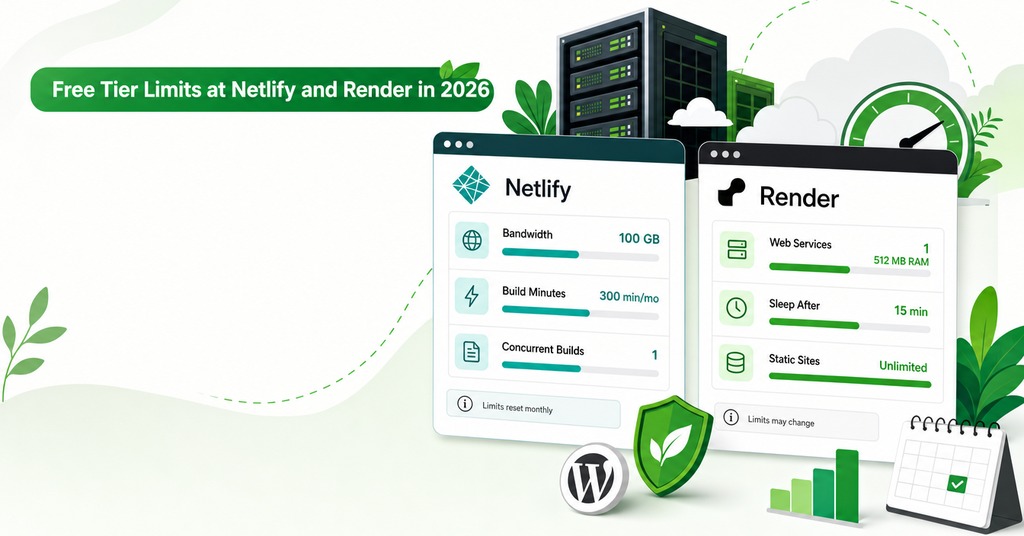
Netlify’s free plan sets a budget where the others set a quota. Every project on the account draws from the same monthly allowance.
What Netlify’s 300 Credits Buy
Credits are spent on deploys, bandwidth, requests and compute at once, at 15 per production deploy and 20 per gigabyte of bandwidth. A site deploying twice a week can exhaust the 300 monthly credits before its traffic does. At the extremes, 300 credits buys around 20 production deploys, or 15 GB of bandwidth, or 1.5 million requests.
Exhausting the budget pauses every project on the account, and visitors find a Site not available page at every URL. Netlify does not bill the overage, and auto recharge is off by default and unavailable on the free plan. Two separate people pasted that gray page into forum threads ten months apart, both times under a submission that had reached a front page an hour earlier.
Render Free Services and the 15-Minute Spin-Down
Render’s own documentation tells users in bold not to run production applications on free instances. A free web service spins down after 15 minutes without inbound traffic and takes about a minute to wake. Whoever is waiting sees a loading page. On a low-traffic site nearly every visitor arrives during a spin-down.
While a free service is spun down, requests to /robots.txt receive a standard disallow-all response that never reaches the service. An idle site therefore tells crawlers not to index it. The filesystem is ephemeral as well. Uploads and local databases are lost on every redeploy or restart, and free Render Postgres databases expire 30 days after creation with no form of backup. Static sites are the exception. They are free and count only against bandwidth and build-pipeline minutes.
How Hard Is It to Move Off Free Hosting?

The deployable artifact on a developer platform is a folder of HTML, CSS, JavaScript and images sitting in a Git repository the business controls. Moving means pointing a different service at the same repository and changing a DNS record. Cloudflare publishes a migration guide from Pages to Workers, and Render publishes guides from Heroku and Railway. On that kind of setup migrating to another provider is a routine operation with nothing to untangle.
A free site builder offers no exit for a different reason. There was never a portable artifact to carry. No custom domain was issued and no URL exists to redirect, and plugins are unavailable on that tier, one of the standing differences between WordPress.com and WordPress.org.
000webhost’s users were told to download their own backups by a date, and whatever was not downloaded by 14 October 2024 was deleted.
The Price of the Cheapest Paid Alternative

Paid hosting starts at $1.94 a month, Fly’s price for the smallest always-on machine at one shared CPU and 256 MB of RAM. The rest of the entry market stays within a few dollars of that. Netlify’s first paid tier is $9, Wix’s cheapest plan is $17, and GreenGeeks’ Lite plan runs $2.95 a month promotional and $13.95 at renewal. Those figures sit against a blackout across every project on an account or a platform closing after 17 years.
The first paid dollar buys a mailbox at the business’s own domain, a backup the platform keeps for longer than a day, a support address that answers and a bill instead of a suspension. No amount of traffic unlocks any of them on a free plan.
Caps matter more than price to the people who have been through this. A hard limit takes the site offline predictably, while an unmetered plan with no stated ceiling fails without warning. Several developers moved to Cloudflare Pages after Netlify’s 2024 billing incident.
The Four Conditions Free Hosting Has to Meet

Free hosting is defensible only for a site that meets all four of these conditions.
Static output. The files were built somewhere else and the host only serves them.
A domain the business owns, which rules out every free site builder.
No payment flow, since the terms usually forbid it and card data has no business passing through a free tier.
Rebuildable from source in an afternoon, so that a terms change costs a day of work.
A plumber, a law firm or a consultancy meets all four when the website is 15 pages of text and photographs plus a contact form handled by a third-party service. Cloudflare Pages will serve that site for the price of the domain name. Documentation sites, changelogs, status pages, pre-launch landing pages and preview environments meet the conditions too. A site with a login, a database or a checkout breaks at least one of them before the domain question is reached.
Frequently Asked Questions

Can you use GitHub Pages for a business website?
GitHub says no. Its usage-limits page bars Pages from being used as free web hosting for an online business or any site directed at facilitating commercial transactions. On the free tier the repository must also be public.
Can I use Vercel’s free plan for a commercial site?
No. Vercel’s Fair Use Guidelines restrict Hobby teams to non-commercial personal use, and commercial usage covers advertising the sale of a product or service and being paid to build or host the site.
Is Cloudflare Pages really unlimited bandwidth?
For web pages, effectively yes. The Pages Free limits page caps builds, files and custom domains while publishing no bandwidth limit. The boundary is content type, since serving video requires a paid product.
What happens when you run out of Netlify credits?
Every project on the account is paused, and visitors find a Site not available page at each URL. Auto recharge is off by default and unavailable on the free plan.
Can free hosting suddenly send you a bill?
On some platforms, historically yes. A static site owner received a $104,000 Netlify bill after a traffic event in February 2024. The 2026 free plan made the credit limit hard, though Render still bills overage bandwidth when a payment method is on file.
Does free hosting hurt your SEO?
No study shows Google penalizing a site for its host. The damage is mechanical. A vendor subdomain cannot carry its links to a new domain, and a spun-down Render service serves a disallow-all robots.txt.
Do free hosting sites put ads on your website?
The site builders do and the developer platforms do not. Free WordPress.com sites display WordPress.com ads, and ad removal is a paid upgrade at both WordPress.com and Wix.
Does free web hosting include email?
No. None of the mainstream free tiers include mailbox hosting at a business domain, and Render Free blocks outbound traffic on ports 25, 465 and 587. Email comes from a separate provider.
What happened to 000webhost?
Hostinger shut it down. The announcement on 8 July 2024 ended signups that day, after 17 years, with full shutdown on 14 October.
Why did Heroku remove its free tier?
Heroku cited abuse, saying its product, engineering and security teams were spending extraordinary effort managing fraud on the free plans. Inactive account deletion began on 26 October 2022 and free dynos ended on 28 November.
Is Render’s free tier good for production?
Its own documentation advises against it in bold. Free web services spin down after 15 minutes of inactivity and take about a minute to wake, the filesystem is ephemeral, and free Postgres databases expire 30 days after creation.
Can a free host delete your website without warning?
The terms generally allow it. InfinityFree reserves the right to discontinue any aspect of its services at any time, and 000webhost gave 98 days’ notice before deleting everything.