Why vendor trust matters more than size in enterprise hosting
Enterprise hosting decisions often start with a familiar assumption: bigger feels safer.
A large vendor has name recognition, recognizable clients, and the kind of brand weight that makes a choice feel easy to defend. But size doesn’t always mean faster support, clearer communication, or stronger accountability.
For enterprise WordPress hosting, trust matters most when a performance issue surfaces, a migration hits a snag, a traffic spike strains the server, a security review turns up something unexpected, or an incident needs a real answer.
In those moments, teams need more than a big logo. They need a hosting partner that responds quickly, communicates clearly, and takes ownership without making them chase updates.
That is why vendor trust often matters more than vendor size.
The problem with choosing based on size alone
A recognizable name can make a hosting decision feel safer. It gives procurement something familiar to point to and gives those involved the comfort of choosing a vendor they already know.
But size can come with tradeoffs.
Larger vendors can bring real advantages such as infrastructure scale, redundancy, and resources that smaller providers can’t match. The problem is that size often comes with structural tradeoffs that only show up when something needs attention. You experience:
- More layers between your team and the people who can solve the problem.
- Support queues that prioritize volume over context.
- Infrastructure, platform, and application teams sitting in separate lanes, where no one feels fully responsible for the outcome.
That doesn’t mean size is disqualifying. Kinsta serves 230,000+ users across Fortune 500 companies, agencies, and high-traffic e-commerce stores. But the support model was built around WordPress engineers on first response, not a tiered escalation system that reaches a specialist only when the situation demands it. The platform is focused on one thing. That focus is what keeps the support model flat and accountable, regardless of how much the company has grown.
The question enterprise teams should be asking isn’t how big the vendor is. It’s whether their structure puts the right people in front of your problem quickly, and whether they stay accountable until it’s resolved.
Trust matters in enterprise hosting
Hosting isn’t just a background service. It sits underneath the parts of the business people notice first. This includes whether:
- The site loads
- Checkout works
- Campaigns survive traffic spikes
- Developers can ship updates without friction
- Security teams get the answers they need
Uptime is the most obvious piece of the puzzle
If the site is unavailable, revenue, lead generation, customer portals, support resources, and internal confidence all take a hit. Recent Splunk research estimates that downtime costs Global 2000 companies about $600 billion a year, with an average cost of $15,000 per minute.
The MarTech Summit, a global series of marketing technology conferences, experienced this directly. In the final weeks before each event, as their team live-edited pages, refreshed landing content, and rolled out announcements, their previous host couldn’t stay online long enough for the team to work with confidence.
Even routine edits sometimes broke pages. “Any downtime meant lost work, delays, and extra pressure on our small team,” says Sophia from The MarTech Summit team. When your website is also your operational hub, every outage stops everything.
Performance matters just as much
Slow pages can affect conversions, search visibility, and how customers perceive the brand. Google reports that 53% of mobile visits are likely to be abandoned when pages take longer than three seconds to load. For an enterprise site, this can show up as fewer demo requests, weaker e-commerce revenue, lower campaign ROI, or more pressure on support teams.
Hall, a WooCommerce development and marketing agency based in Maine and recognized as one of the Original eight WooExperts, saw this problem firsthand. Before switching to Kinsta, one of their WooCommerce clients repeatedly crashed during high-traffic periods. At the time, the client was generating $3M in annual revenue and struggling to stay online during peak sales. The site’s instability was a direct constraint on growth.
Security adds another layer
Hosting touches backups, access controls, malware monitoring, isolation, updates, and incident response. When something looks suspicious, teams need clear answers fast. The stakes are high: IBM’s 2025 Cost of a Data Breach Report puts the global average cost of a breach at $4.44 million.
Developer workflows depend on hosting, too
Staging environments, deployments, cache management, redirects, database access, logging, and rollback options all affect how quickly teams can work. A slow or rigid hosting setup creates drag. Small delays pile up across releases, QA cycles, and urgent fixes.
Hall’s development team specifically needed SSH access and WP-CLI support on a managed platform before they were willing to move. Not because those features are rare, but because their absence would have made their entire workflow dependent on a hosting environment that didn’t fit how they built sites. The technical requirements came first. Everything else followed.
Customer experience ties it all together
A visitor doesn’t separate hosting from the website. They just know the page is slow, the form failed, the cart timed out, or the login screen won’t load.
That’s why trust matters. When issues happen, enterprise teams need clear answers, not vague updates or long ticket chains. A trustworthy hosting provider explains what’s happening, what’s being done, and what comes next. That way, internal teams can move faster and make better decisions.
Where large-vendor support can fall short
Large vendors often have deep technical resources. The problem is access.
In many enterprise support models, the first response comes from a general support queue. From there, the issue may move to a platform team, an infrastructure team, a security team, an account manager, or a higher-tier escalation path. Each handoff adds time. It can also strip away context, especially when the issue is complex or urgent.
That creates a familiar problem for enterprise teams: they spend too much time restating what happened instead of getting closer to a fix.
Responsibility can get blurry, too. A performance issue may involve hosting infrastructure, WordPress configuration, caching, a plugin, a CDN, or database queries. If each layer belongs to a different team, the customer may hear a version of, “That part isn’t ours.” Technically, that may be true. Operationally, it isn’t very helpful.
Incident communication is another weak spot. Updates may arrive slowly, use generic language, or avoid specifics until the issue is fully understood. But internal teams can’t wait for perfect certainty. They need to know what is affected, what’s being investigated, what’s been ruled out, and when to expect the next update.
The support gap is rarely about whether a large vendor has capable people. They usually do. It’s about how many steps sit between your team and those people when something needs attention.
Why responsiveness builds confidence
Responsiveness matters because it reduces the number of unknowns. When a production site slows down, throws errors, or behaves unpredictably after a deployment, the technical issue is only part of the problem. The other part is uncertainty.
- Is the issue isolated or widespread?
- Is it tied to the application, the database, caching, DNS, a plugin, or the hosting environment?
- Is customer traffic affected?
- Does the team need to roll back, pause a campaign, alert leadership, or wait?
A responsive hosting provider helps answer those questions quickly.
That doesn’t always mean the issue is fixed in the first reply. But it does mean someone knowledgeable is looking at it, asking the right questions, and narrowing the path to resolution. A clear first response can save an internal team from guessing, over-escalating, or wasting time in the wrong part of the stack.
The MarTech Summit’s team had no in-house developer to lean on when something went wrong. Every technical issue became a blocker for the marketing team. “We had difficulty identifying the root cause of technical issues,” Sophia explains. What they needed wasn’t just faster responses. They needed a partner who could take ownership of the diagnosis without requiring them to understand server infrastructure first. That’s a different kind of support relationship than a ticket queue provides.
Fewer support layers help here. When teams don’t have to move through multiple queues before reaching someone with WordPress and infrastructure context, diagnosis can happen faster. Logs can be reviewed sooner. Cache behavior can be checked. Resource usage, error patterns, and recent changes can be connected more quickly.
Clear communication builds confidence, too. Enterprise teams need updates they can act on:
- What is known
- What is being investigated
- What has changed, and
- What happens next
Even a short, specific update is better than a vague “we’re looking into it.”
That kind of responsiveness creates trust over time. Not because nothing ever goes wrong, but because when something does, the provider stays visible, engaged, and accountable until the issue is resolved.
Why transparency is part of trust
Enterprise teams don’t need a hosting provider to pretend every issue is simple. They need one that communicates clearly when the situation is still being sorted out.
That matters during incidents, migrations, performance reviews, and security conversations. A strong provider explains what’s known, what’s still being investigated, and what tradeoffs may affect the next step.
Konica Minolta, the global technology company, faced exactly this kind of high-stakes moment when their legacy Kentico DXP platform reached end of life. They needed to migrate a large, complex enterprise site to WordPress without losing search traffic, without downtime, and without the months of uncertainty that often accompany major replatforming projects.
The migration was completed in three months with zero downtime, zero data loss, and no dip in search traffic. Konica Minolta has recorded 100% uptime since launch. That outcome wasn’t just a result of good infrastructure. It required a migration team that communicated clearly throughout, managed tradeoffs transparently, and took accountability for the outcome rather than leaving the client to coordinate across teams.
Transparent communication gives technical teams room to plan. It helps them brief leadership, adjust timelines, avoid surprises, and make decisions with the right context, rather than filling in the gaps themselves.
Why operational alignment matters
A hosting partner should fit how an enterprise team already works, not force the team to bend to rigid processes.
That includes practical details like staging environments, deployment workflows, user permissions, cache management, rollback options, traffic scaling, security reviews, and reporting. These aren‘t minor conveniences. They affect how quickly teams ship updates, test changes, respond to issues, and prove compliance internally.
Operational alignment also matters across departments. Developers may need clean workflows and useful logs. Security teams may need clear documentation and access controls. Marketing teams may need confidence that campaign traffic won’t strain the site. Leadership may need reporting that explains performance and risk in plain language.
Hall’s experience illustrates what misalignment costs. Before moving to Kinsta, their hosting environment with a previous provider wasn’t built around how a development-led agency actually operates. The workflows that mattered to their team weren’t first-class features.
After switching, Hall’s president Thomas Hall described it plainly: “In the decade since, Kinsta has stayed ahead of the competition in terms of performance and features. We have stayed happy with Kinsta and the constant improvements that improve our sites without our involvement.” That last phrase matters. Improvements that happen without the team’s involvement are improvements that don’t create work. That’s a different kind of hosting relationship.
The right hosting provider supports that operating model. They make the team’s work easier to manage, easier to explain, and easier to scale.
How Kinsta fits this model
Kinsta fits this model by focusing on the parts of enterprise hosting that build trust over time: clear communication, responsive support, and direct accountability.
Instead of giving teams a broad cloud platform to configure and manage on their own, Kinsta provides managed WordPress hosting built around WordPress-specific needs. Its enterprise hosting includes support and migration teams that work as an extension of the customer’s team, which matters when technical decisions need context rather than canned replies.
That focus helps reduce friction. When something needs attention, enterprise teams aren’t just looking for a ticket number. They need someone who understands WordPress, hosting infrastructure, performance, caching, migrations, and the business pressure behind the request. Kinsta describes its managed WordPress hosting around “real engineer support” for business-critical WordPress sites and 24/7/365 support from WordPress experts.
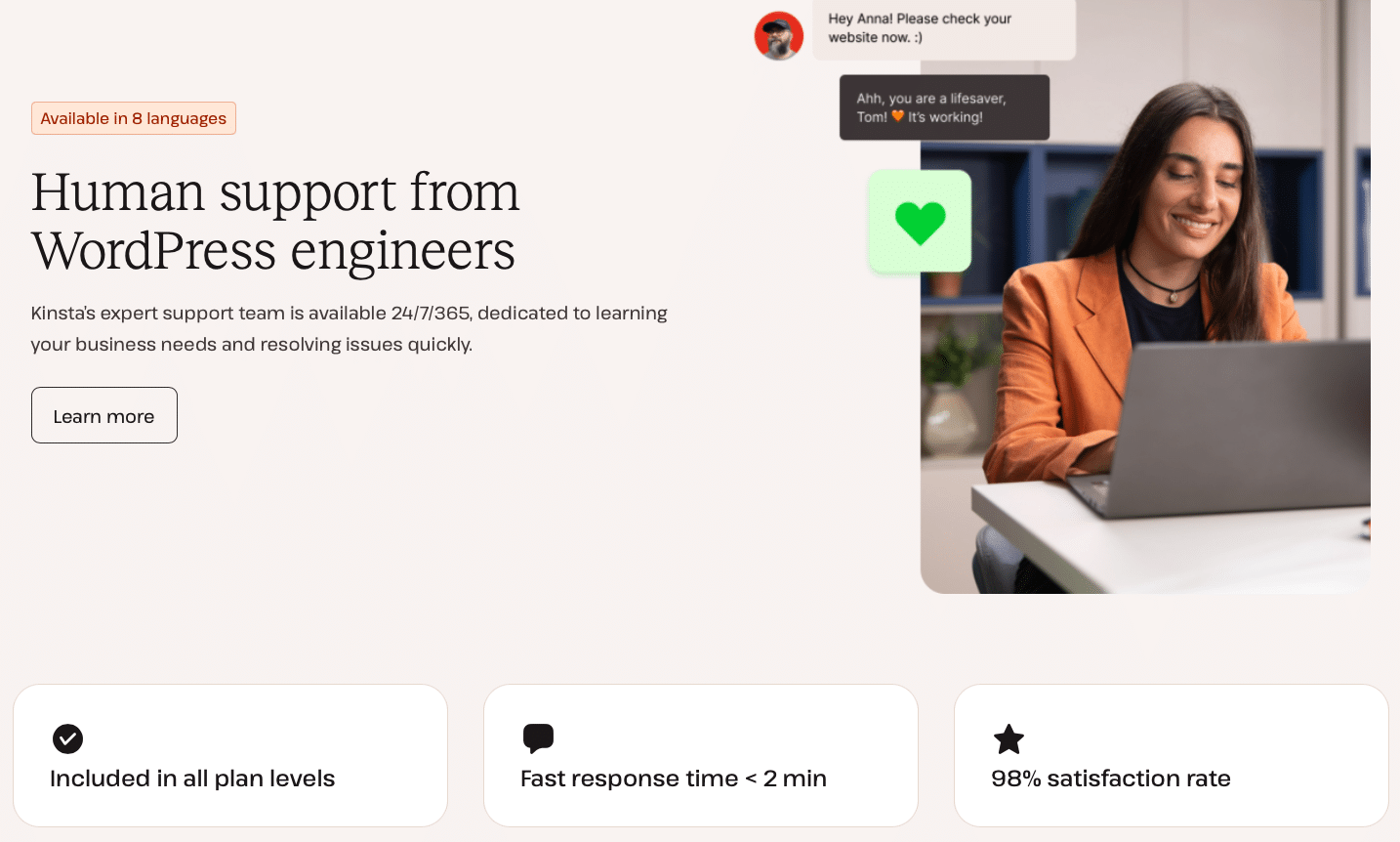
Kinsta also gives teams a more focused platform to work from. Features like staging environments, backups, security tooling, user permissions, logs, and performance-focused infrastructure help support the day-to-day operating model of enterprise teams rather than adding another layer of complexity.
The result is a hosting relationship built around practical support. Kinsta gives enterprise teams a partner designed around performance, communication, and WordPress-specific expertise. These are all the things that matter most when the site needs to stay fast and be manageable.
What enterprise teams should look for in a hosting partner
Enterprise teams should evaluate hosting partners by how they behave when something needs attention, not just by what they promise during sales.
- Look for clear ownership first. When an issue comes up, the provider should know who’s responsible, what’s being investigated, and how the next step gets handled. No making your team chase three different teams for one answer.
- Support should be fast and knowledgeable. A quick reply doesn’t help much if it only asks for information your team already provided. The right partner brings WordPress-specific experience to the conversation and can connect the dots between infrastructure, caching, plugins, performance, database behavior, and traffic patterns.
- Transparent communication matters. During incidents, migrations, and performance work, enterprise teams need updates they can share internally. What happened? What is affected? What is being done? What should the team expect next?
- The infrastructure should support predictable performance. That means the platform can handle traffic swings, support secure workflows, provide useful tooling, and help teams manage changes without unnecessary risk.
- The relationship should feel collaborative. A good hosting partner doesn’t treat enterprise support as a transaction. They learn how your team works, understand what the site supports, and help you make better decisions over time.
Choose accountability over name recognition
Large vendors may feel like the safest option at first. The name is familiar. The footprint is large. The choice is easy to explain.
But enterprise hosting trust isn’t built on name recognition alone. It comes from how a provider responds, how clearly they communicate, and how well their platform supports the way your team actually works.
For enterprise WordPress sites, that matters every day. During launches. During traffic spikes. During incidents. During the routine work of keeping a business-critical site fast, secure, and dependable.
Kinsta gives enterprise teams a high-accountability hosting partner built around clarity, performance, and support that doesn’t disappear behind layers. Instead of choosing the biggest logo in the room, teams can choose a provider that stays responsive, transparent, and focused on the work that keeps their site moving.

Kinsta
Joel is a Frontend developer working at Kinsta as a Technical Editor. He is a passionate teacher with love for open source and has written over 300 technical articles majorly around JavaScript and it’s frameworks.