The 10 Best Ecommerce Platforms in 2026 [Reviews]
Key takeaways
Look into factors such as budget, scalability, hosting, and customization needs when choosing the best ecommerce platform for your business.
Each ecommerce platform stands out for different uses, but generally Shopify, BigCommerce, WooCommerce, Wix, and Adobe Commerce are among the top ones.
If ranking high on search results is your top priority, choose ecommerce software with more customization options rather than easy ecommerce website builders.
If you’re planning to start an ecommerce business, the first thing you’ll need is a tailored online store platform.
The best ecommerce platforms make it easy, even for small businesses, to sell products and accept payments on your website while streamlining various aspects of a typical ecommerce workflow.
Different ecommerce tools are made for different types of businesses. With so many choices, you’ll need to pay attention to features before picking what’s best for you.
To make your decision easier, we’ll look at ten of the most popular ecommerce website builders available in 2026.
In this post:
How to choose an ecommerce platform
Ecommerce platform comparison
Best ecommerce platforms
- Shopify
- BigCommerce
- WooCommerce
- Wix
- Adobe Commerce (Magento)
- Squarespace
- Weebly
- PrestaShop
- Ecwid by Lightspeed
- Volusion
Ecommerce platforms: FAQs
Ecommerce platforms: Wrap up
Get a top email marketing app that works on any ecommerce platform
Quick sign up | No credit card required
How to choose an ecommerce platform
Maybe you run your business exclusively online, or own a physical store and need an online outlet. Whatever your situation is, here are some items to consider before choosing a suitable ecommerce platform.
- Budget: You can get simple ecommerce platforms ranging from $10 to complex ones that cost over $500/month, depending on your budget.
- Scalability: You’ll need to choose an ecommerce platform that grows with your business and meets your business needs at each level.
- Hosting: Depending on your business structure, you can choose a cloud-hosted or a self-hosted ecommerce platform.
Cloud hosting can be managed or unmanaged. The technology is the same, but unmanaged plans are tricky to set up and run. Most people prefer managed cloud services because starting a new project with them is quicker and easier. Some VPS comparisons show detailed info on both types of hosting. - Customization: Websites with customizable features give you more control over what your ecommerce platform looks like and how it functions.
- Customer support: Choose an ecommerce platform with a proactive and responsive customer support team.
- Robust product catalog: Having more items in your product catalog lets you provide more details about your products, helping customers make a quick purchase decision.
- Functionality and ease of use: Choose an ecommerce platform that gives your customers the best shopping experience.
You’ll need to consider all these factors before choosing a suitable ecommerce platform for your business.
In the next section, you’ll find a quick comparison of the best ecommerce platforms on critical parameters. These include hosting, source code editing, and integrations with third-party applications:
How we evaluated the best ecommerce platforms
We based our top picks for the best ecommerce platforms on our own testing, cross-referenced with other users’ experiences in G2 reviews. Coupled with top industry data from Enlyft, we were able to narrow it down to the 10 best ecommerce website builders.
We looked into some common criteria for evaluating ecommerce stores:
- Ease of use is about how intuitive the platform is for non-technical users to set up and manage. Drag-and-drop interfaces, dashboard convenience, access to source code, and similar features are relevant.
- Flexibility shows how well the platform adapts to different business models. It’s mostly relevant in cases when your e-commerce store’s focus shifts over time.
- Third-party integrations with marketing tools, accounting, warehouse management software, and others are important. A large app marketplace is something to look for here.
- Scalability can make or break your business’s growth by enabling options for handling traffic spikes, expanding product catalogs, or entering new markets. Note that it differs for self-hosted and hosted ecommerce platforms.
- Value is the overall return relative to the platform’s cost. While some platforms are clearly more powerful, it might not be worth the money if subscription costs eat up your budget.
Each tool is labeled for a specific use case, indicating the level of technical knowledge required and the support you can expect. It’s a general guideline, as the best website builder for small-business ecommerce, for example, is unlikely to fit enterprise use.
It’s important to think about the specifics of your ecommerce store from the start. Some platforms require monthly subscription fees, while others are free but include additional costs. Expenses for self-hosting, third-party plug-ins, or even transaction fees might become more apparent considering your use case.
Ecommerce platform comparison
Quick ecommerce platform comparison
Let’s take a quick look at how each of these ecommerce platforms compares.
| Hosted /self-hosted | Technical knowledge needed | Designed themes | 3rd party apps | Able to edit source code | Ease of use rating | |
|---|---|---|---|---|---|---|
| Shopify | Hosted | No | In-house | Yes | Yes | 5 |
| Bigcommerce | Hosted | No | In-house | Yes | Yes | 4 |
| Woocommerce | Self–hosted | Yes | Outsourced | Yes | Yes | 3 |
| Wix | Hosted | No | In-house | Yes | No | 4 |
| Adobe Commerce (Magento) | Both | Yes | Outsourced | Yes | Yes | 1 |
| Squarespace | Hosted | No | In-house | Yes | Yes | 5 |
| Weebly | Both | No | In-house | Yes | Yes | 5 |
| PrestaShop | Self-hosted | Yes | In-house | Yes | Yes | 2 |
| Ecwid by Lightspeed | Hosted | No | In-house | Yes | Yes | 4 |
| Volusion | Hosted | Yes | Outsourced | Yes | Yes | 2 |
This next section outlines what each platform is best for.
- Shopify — Best for ecommerce beginners
- BigCommerce — Best for big online businesses
- WooCommerce — Best for businesses using WordPress
- Wix — Best for individual sellers or smaller stores
- Adobe Commerce (Magento) — Best for businesses with technical resources
- Squarespace — Best for templates and themes
- Weebly — Best and easiest to use for micro businesses
- PrestaShop — Best for platform customization
- Ecwid by Lightspeed — Best for existing sites
- Volusion — Best for stores looking to expand
Now let’s walk through some of the pros and cons of Shopify, one of the most commonly used ecommerce platforms in 2026.
1. Shopify
- Best for ecommerce beginners
- Rating: 4.4 out of 5
- Ease of use: 5
- Top industries that use Shopify: Retail, apparel & fashion, manufacturing

If you’re interested in ecommerce, you’re probably already familiar with the Shopify ecommerce platform. With millions of businesses in 175 countries around the world, Shopify is one of the most prominent ecommerce solutions.
The tool comes with everything you need to launch your store, including hosting, CMS, database configuration, and SSL certificates. You also get additional features, such as inventory management and advanced reporting tools.
A wide range of mobile-optimized ecommerce themes is available. As with all of the best ecommerce solutions, these themes are ready to be used out of the box and can easily be customized to match your brand’s colors and styles.
Shopify also provides basic marketing tools for ecommerce beginners, and you can find more robust options in the Shopify Marketplace. The marketplace contains free and paid apps for optimizing store merchandise and sending abandoned cart recovery emails.
While Shopify isn’t the cheapest option for small businesses, it comes with a comprehensive ecommerce package. It’s an ideal choice for non-technical users who value simplicity and ease of use.
Pros
- Multiple integrations with third-party applications like QuickBooks
- A user-friendly interface
- Option to accept recurring payments for subscriptions
- A mobile app for both iOS and Android
Cons
- The higher-tier plans are expensive
- There’s a limited number of free customizable themes
Pricing
- Basic: $29/month
- Grow: $79/month
- Advanced: $299/month
- Plus: from $2300/month
Note: You may also have to pay extra transaction fees if you don’t use Shopify Payments.
Customer support
Phone support, email support, live chat, the Shopify Help Center, social media, and community forums.
Get your email marketing set up quickly with Omnisend’s direct, one-click integration with Shopify
Quick sign up | No credit card required
2. BigCommerce
- Best for big online businesses
- Rating: 4.2 out of 5
- Ease of use: 4
- Top industries that use BigCommerce: Retail, manufacturing, and food & beverages.
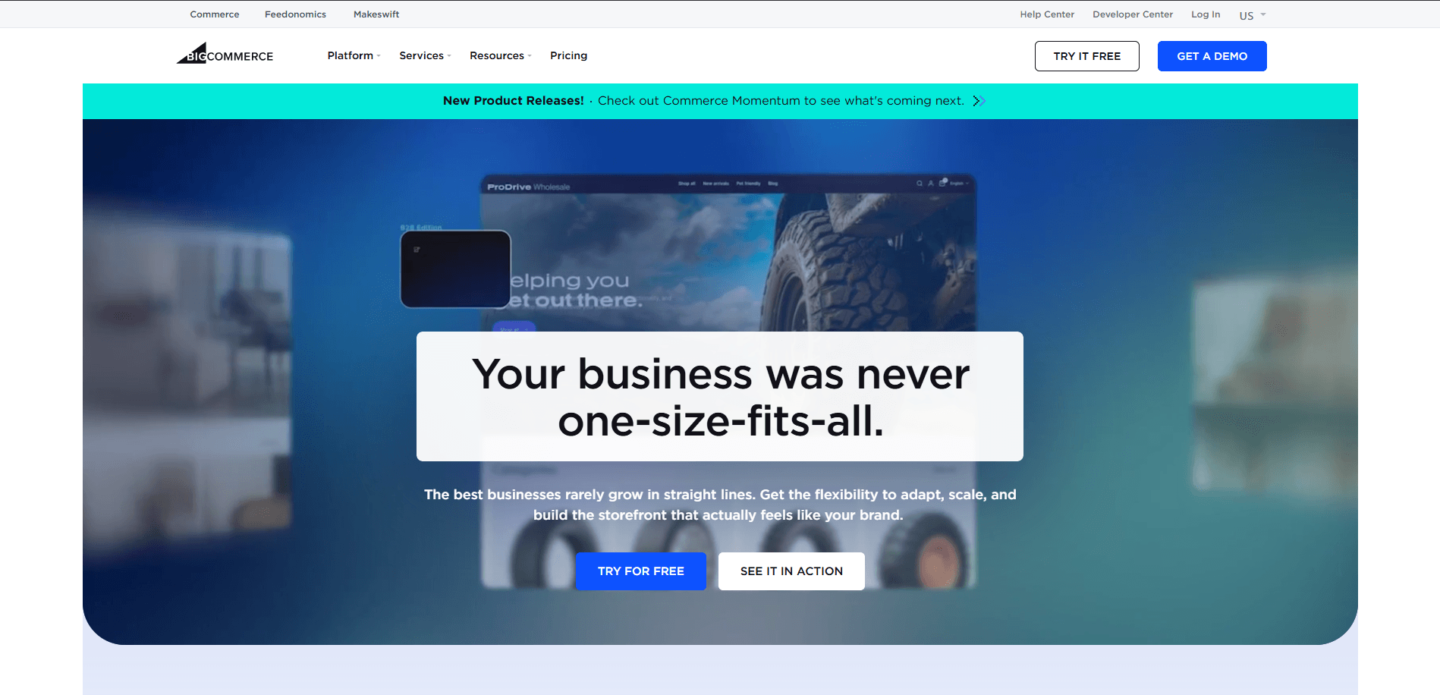
BigCommerce is a sophisticated ecommerce website builder and sales platform that’s ideal for both growing small businesses and established enterprises.
The platform is a little more complex to use and understand compared to Shopify.
However, if you have some technical experience, then you shouldn’t have trouble using BigCommerce as an ecommerce platform. Its robust set of features and a lack of transaction fees make up for the complexity.
Like other ecommerce platforms, there are more than 100 BigCommerce themes for merchants, some of which are free. These themes are easy to customize, giving you control over backgrounds, font colors, logos, checkout, and more.
Like Shopify, you can complement BigCommerce with third-party extensions for an even wider range of functions, like customer data and inventory management or email and SMS marketing.
Pros
- It’s easy to accept payments in multiple currencies
- There’s a good reporting tool included in all plans
- It comes with an easy-to-use drag-and-drop page builder
- You can try the tool for free for the first 15 days
Cons
- Abandoned cart functionality is not available on its basic plan
- There’s a limit on online annual sales for each plan, and exceeding it means you’d have to upgrade
- Free themes are too similar to each other
Pricing
- Core: $29/month
- Growth: $79/month
- Scale: $299/month
- Performance: custom pricing
Customer support
Phone support, live chat, support tickets, Help Center, and support forums.
If you’re on BigCommerce, you can quickly get your email marketing set up with our one-click BigCommerce integration. Find out more.
3. WooCommerce
- Best for businesses using WordPress
- Rating: 4.4 out of 5
- Ease of use: 3
- Top industries that use WooCommerce: Retail, food and beverages, and construction
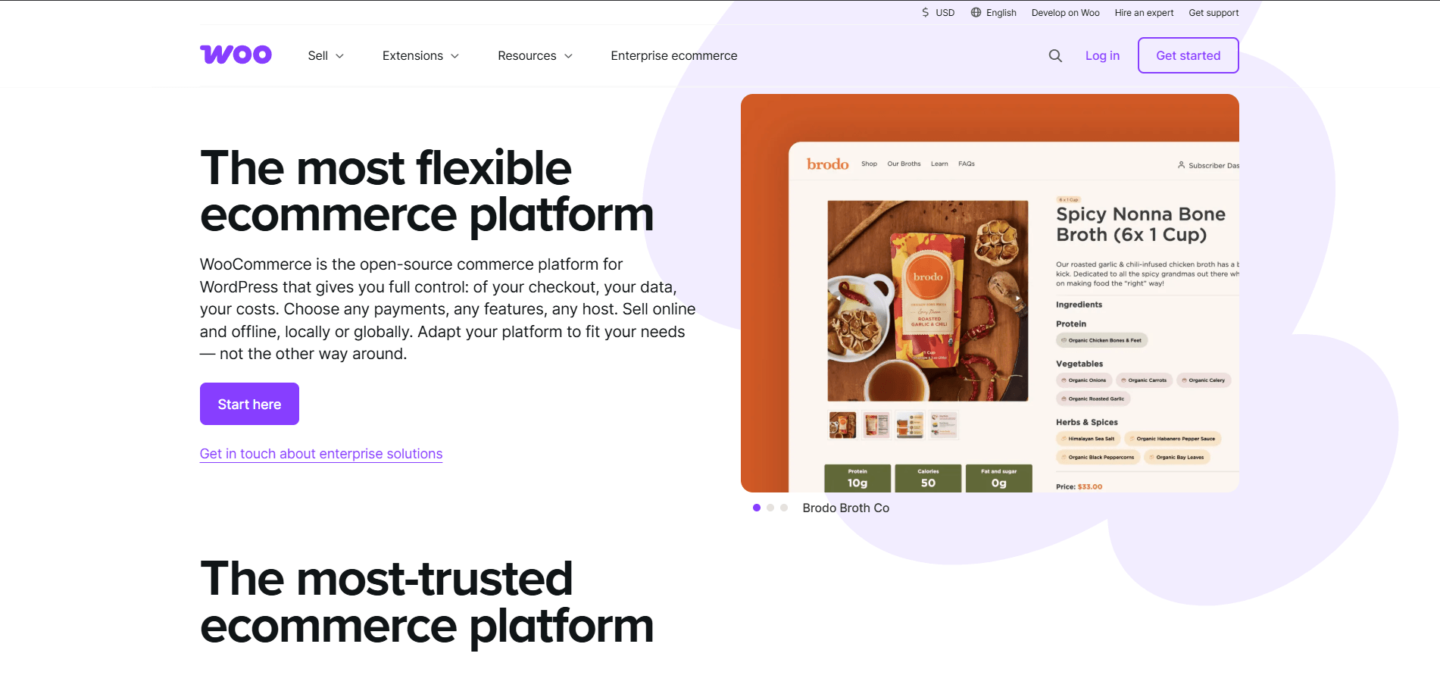
WooCommerce is one of the best ecommerce platforms for small businesses with a self-hosted WordPress website. It’s a plugin that enables you to turn your WordPress website into an ecommerce store.
Unlike Shopify, which offers a quick and straightforward setup, setting up WooCommerce requires some technical expertise. For starters, you’ll need to learn to set up WordPress and have a domain, SSL certificates, and a web hosting solution.
We suggest building your WooCommerce website on Kinsta’s Premium Managed Hosting. Kinsta guarantees blazing-fast website performance, easy scalability, bulletproof malware protection, and more.
The Kinsta platform is optimized for WooCommerce sites and is capable of supporting high-traffic, resource-intensive ecommerce sites. Give them a try today and find out how you can get an ecommerce site that is up to 39% faster.
The upside to learning all this is that WooCommerce is highly customizable.
You’ll have multiple add-ons, like email and SMS marketing plugins, WooCommerce themes, payment solutions, etc., to customize your online store. Some of these add-ons you can use for free.
The downside is that novices and small businesses may have more trouble optimizing their site than they would with a more straightforward ecommerce website builder like Shopify or Wix.
WooCommerce is based on WordPress, so it’s a great choice for vendors who want to leverage blogging and content marketing for SEO.
Check out our guide to the best WooCommerce software to find out how to get even more out of this ecommerce software platform.
Pros
- It’s free to use if you have a WordPress website
- Many payment gateways with no platform transaction fees
- Multiple add-ons are available
- Great customization options
Cons
- You’ll need a domain, web hosting, and an SSL certificate
- You’ll need prior knowledge of using WordPress
Pricing
Free plugin.
Customer support
Live chat support, self-service guide, FAQ page, support ticket.
4. Wix
- Best for individual sellers or small stores
- Rating: 4.2 out of 5
- Ease of use: 4
- Top industries that use Wix: Business services, hospitality, manufacturing

Wix is a hosted ecommerce website builder with separate plans for websites, ecommerce stores, and enterprise-level solutions.
Along with an intuitive and beginner-friendly drag-and-drop editor, Wix also offers infrastructure, SSL certificates, and a free domain for one year with all paid subscriptions.
Unlike other ecommerce platforms, Wix offers lots of high-quality store templates for users. Its plans have robust features to improve the online shopping experience, including abandoned cart recovery, recurring payments, and the ability to sell unlimited products.
Unlike other ecommerce platforms, Wix is more of a website builder with some ecommerce features than a dedicated ecommerce solution. As such, you may miss out on some of the features that come with other Wix alternatives.
Fortunately, the Wix App Market gives site owners access to a wide range of additional Wix apps.
Another item that sets Wix apart from other ecommerce platforms is its gorgeous website design templates. The tool provides over 85 customizable ecommerce templates for free.
While it’s convenient to build a Wix website from scratch, you’ll be missing out on some of the best collections of email templates and other marketing solutions from other tools.
Wix has an in-built email marketing and customer data management solution, Wix Ascend, to help with your marketing campaigns. We covered it in a separate pricing guide from the main Wix plans.
Pros
- It’s an all-inclusive hosting solution with domain and SSL certificates
- Has over 85 free templates
- You can sell unlimited products
- It’s beginner-friendly
Cons
- The basic plan has limited storage of only 50 GB
- There are only a few dropshipping integrations
Pricing
- Light: $17/month
- Core: $29/month
- Business: $39/month
- Business Elite: $159/month
- Free
Customer Support
Phone support, live chat, and Wix Help Center.
5. Adobe Commerce (Magento)
- Best for businesses with technical and programming resources
- Rating: 4.0 out of 5
- Ease of use: 1
- Top industries that use Magento: Retail, information technology and services, manufacturing
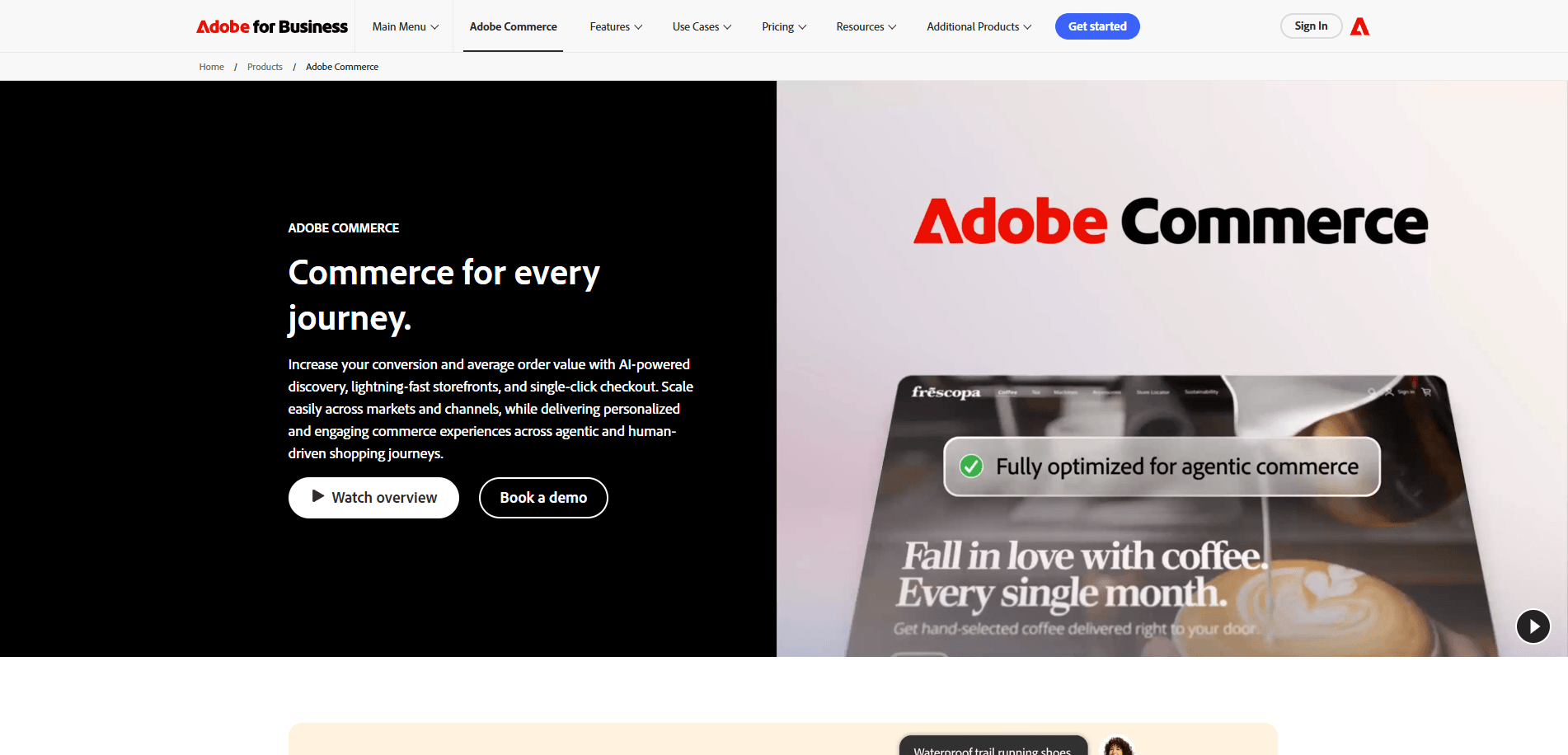
Formerly Magento, Adobe Commerce is an independent ecommerce solution and one of the top enterprise ecommerce platforms. Unlike the ecommerce platforms discussed previously, this service was primarily designed for larger organizations.
The setup is difficult, and you’ll need experienced developers to configure hosting, security certificates, your domain name, and other elements.
The Adobe Commerce solution also provides additional tools such as an intuitive Page Builder, advanced marketing features, and customer loyalty programs.
The Adobe Commerce marketplace offers extensions for everything from customer service to payment processing and order management. While the base platform is robust on its own, you can add a wide range of extra functions through both free and paid extensions.
The sky’s the limit with Magento.
Adobe Commerce might be the best enterprise-level ecommerce platform, so consider it if you have a mid-to-large-sized business and a team of skilled developers to handle the technical side of the platform.
For your ecommerce marketing needs, you can use Omnisend’s plugin source code to build reliable, flexible integrations with Adobe Commerce.
Pros
- The tool provides unlimited personalization capabilities
- It integrates with other products in the Adobe suite
- It has advanced analysis features
Cons
- It’s not suitable for small businesses
- Requires technical knowledge
Pricing
The Adobe Commerce platform is available for a custom price depending on your selling volume. Contact Adobe directly to get a quote for your business.
Customer Support
Customer support options: Customer success manager, Magento Help Center, customer support forums.
6. Squarespace
- Best for templates and themes
- Rating: 4.4 out of 5
- Ease of use: 5
- Top industries that use Squarespace: Business services, hospitality, and manufacturing.

Squarespace is a well-known ecommerce platform that allows you to create not only online stores but also any other type of website you’d like.
One of its main advantages is its wide range of beautiful templates and themes, many of which users get for free. A lot of Squarespace’s themes are not only focused on selling but also on looking good while doing so.
Squarespace includes a free custom domain (for one year), SSL for all of its plans, storage, hosting, and more. It’s relatively easy to use and set up, with a drag-and-drop builder that helps you create your website fast.
The ecommerce platform also has great uptime reliability compared to other website builders. That means you can be sure your store will be online for your visitors to access at all times.
Since Squarespace isn’t built exclusively for ecommerce, its marketing tools are not as extensive as those of other ecommerce platforms like Shopify and BigCommerce.
If you’re looking to extend Squarespace’s capabilities, you can utilize their Extensions marketplace.
Pros
- It has affordable plans even for small businesses
- No technical experience is required
- Free quality ecommerce templates
Cons
- Abandoned cart recovery is not a standard feature
- No free options
Pricing
- Basic: $16/month
- Core: $23/month
- Plus: $39/month
- Advanced: $99/month
Note: Additional transaction fees of 2% apply to the basic plan.
Customer support
Email support, help center, webinars, and forums
7. Weebly (now part of Square)
- Best (and easiest to use) for small businesses
- Rating: 4.2 out of 5
- Ease of use: 5
- Top industries that use Weebly: Business services, retail, organizations
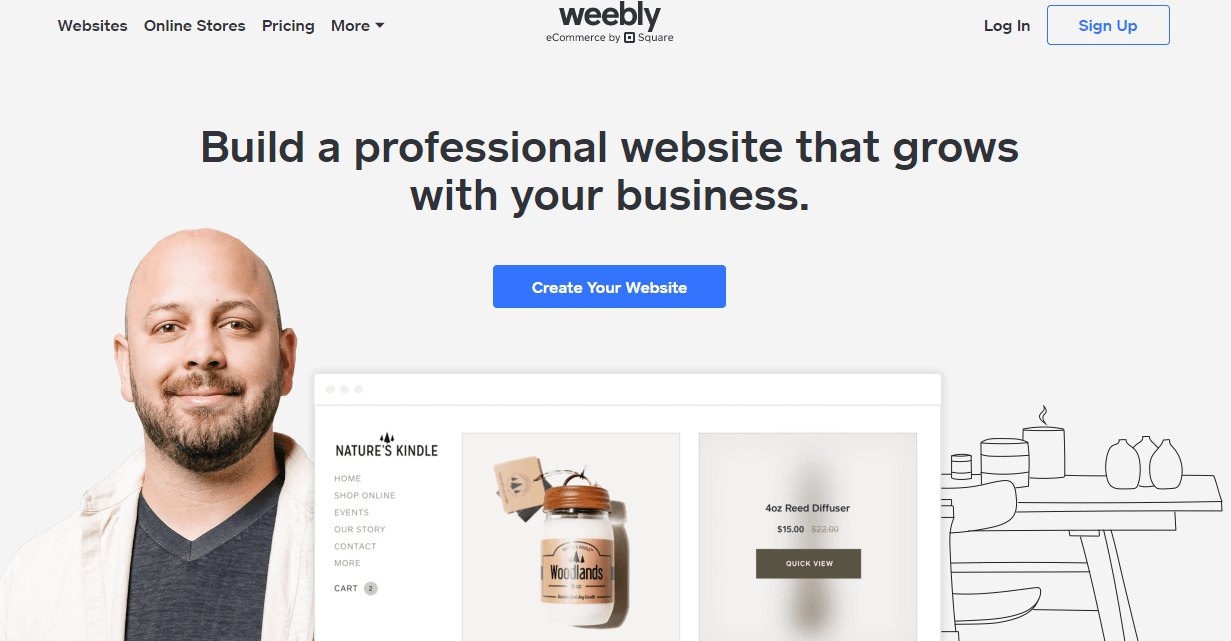
Weebly (now a part of Square’s suite of tools) is one of the easiest website builders to use, allowing you to get your ecommerce store up and running in no time. Weebly isn’t exclusively for ecommerce, so some of its plans will not work for selling products in online stores.
Because it’s one of the easiest-to-use ecommerce platforms, getting started with Weebly is almost effortless. For online stores, merchants get a free domain and Google Ads credits with every plan.
The tool offers a free tier that lets you get your website up and enjoy some features without any financial investment.
Weebly has a large variety of unique layouts for its page designs. These designs range from basic styles to sophisticated ones, depending on your needs and budget. You can edit these templates to customize them to your ecommerce business needs.
In terms of SEO, Weebly allows you the basic capabilities to customize ALT texts, metadata, titles, tags, URLs, and so on.
For marketing, you can use Weebly’s App Center, which has interesting apps for your marketing campaigns. Unfortunately, it’s incomparable to Shopify’s App Store and only suited for beginners.
Pros
- Has a free plan
- Suitable for small businesses
- Affordable pricing
- Offers a free domain and SSL certificate
Cons
- Some design templates are too simple
- Can’t connect a custom domain on the free tier
Pricing
- Free plan
- Personal: $11/month
- Professional: $17/month
- Performance: $30/month
Customer support
Phone support, chat and email support, and community forum
8. PrestaShop
- Best ecommerce platform for customization
- Rating: 4.3 out of 5
- Ease of use: 2
- Top industries that use PrestaShop: Retail, information technology and services, and computer software.
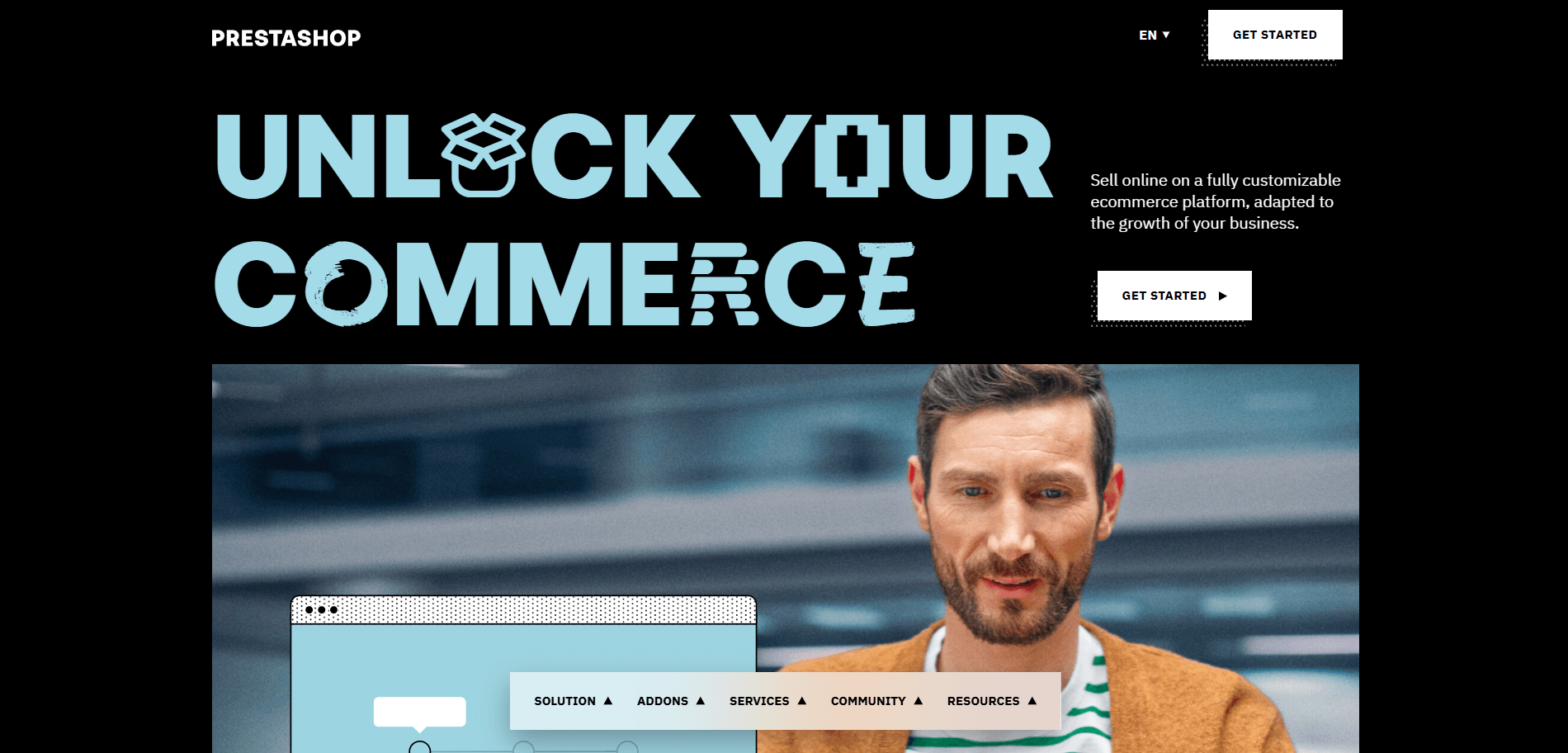
PrestaShop is one of the many comprehensive ecommerce platforms for businesses of all sizes. The tool offers professional themes, order management, social media marketing, support for multiple languages and currencies, and other critical features.
PrestaShop doesn’t offer hosting, domain names, or other basic features, so you’ll need to install it on an existing server. This makes comprehensive solutions like Wix better for those who don’t want to deal with things like hosting or domain names.
However, it’s easy to get used to PrestaShop’s functionality over time once you get past the initial setup.
PrestaShop comes with a deep collection of customizable themes for virtually any industry you can think of. Most of these themes are costly (between roughly $100 and $200), so you should be confident in a template before committing to it.
After setting up a theme, you can quickly customize nearly every aspect of the design, including checkout and product pages.
Even small businesses can accept a wide range of payment methods with PrestaShop without additional platform transaction fees. Making payments as convenient as possible for each unique buyer maximizes your store’s potential audience.
The tool has marketing add-ons like PrestaShop Facebook for social media integration, PrestaShop Marketing, etc.
Pros
- It’s a free tool to download and use, even without extensions
- It’s an open-source platform that lets you customize everything
- The store offers unlimited listings
Cons
- You need some coding knowledge to customize your store
- Takes a long time to set up
- The integrations are costly
Pricing
Free
Customer support
Help Center and customer support forums.
9. Ecwid by Lightspeed
- Best free ecommerce solution
- Rating: 4.7 out of 5
- Ease of use: 5
- Top industries that use Ecwid: Construction, retail, and consumer services.
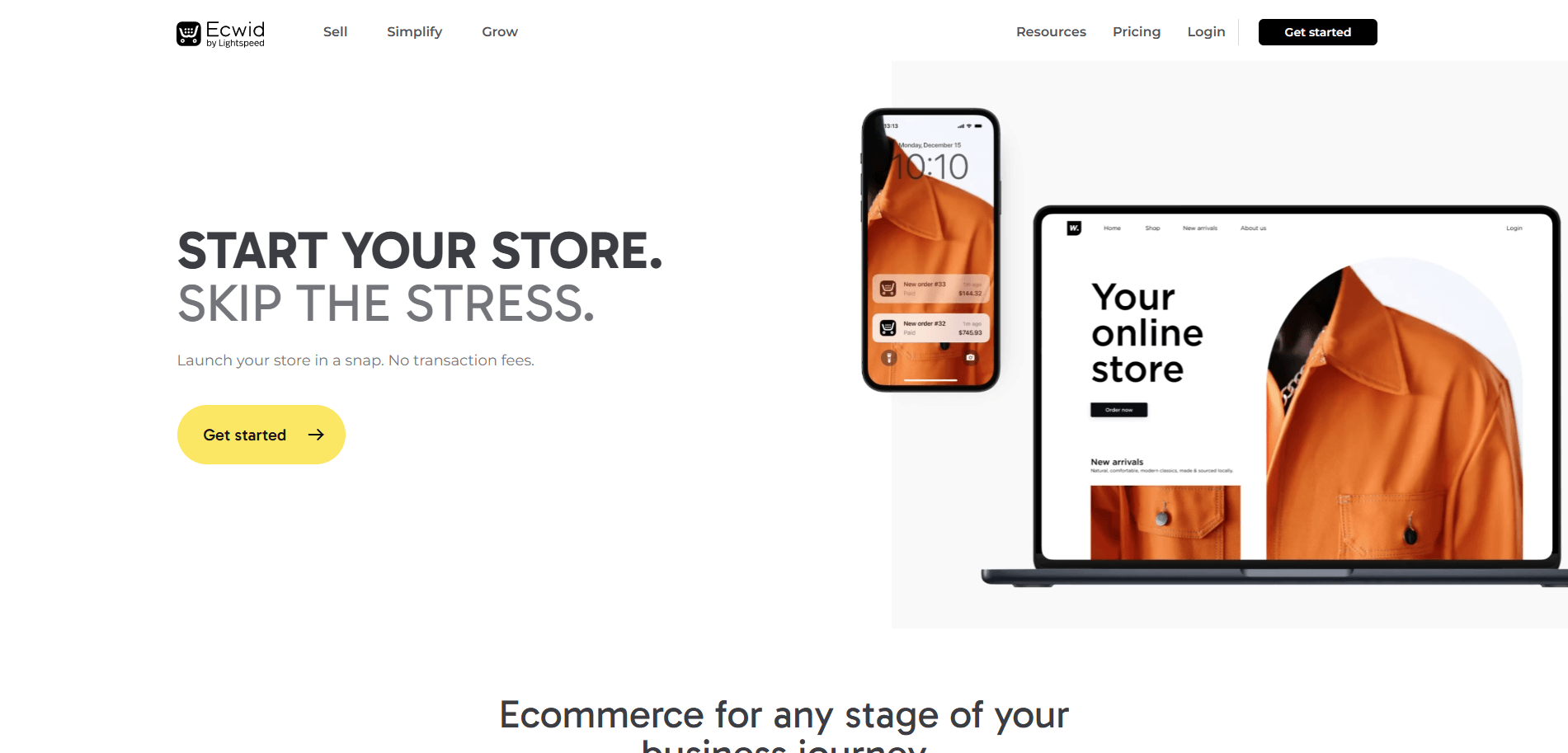
Ecwid is a great ecommerce platform, owing to its ease of use and free ecommerce solution. The tool lets you set up an online store on an existing website.
You can, however, opt for their standalone site, but it’s more of a widget than a complete website. It’s only a one-pager, which may be suitable if you’re selling one product. But if you’re selling multiple products, it’s easier to have Ecwid as part of another website.
This tool easily integrates with other websites, including Wix, WordPress, and Weebly. It provides you with over 70 themes to choose from for your ecommerce store section.
The Ecwid App Market provides more integrations and extensions for more functionality. These include tools to help with your design, marketing, dropshipping, product catalogs, shipping, order management, accounting, reporting, and much more.
This tool offers an affordable starter plan, which sets it apart from ecommerce platforms like Shopify.
Ecwid limits the number of products you can sell on your online store depending on your payment plan. The higher-priced plan you choose, the more products you can sell on the platform.
For instance, their starter plan is limited to only up to 10 products. While this may be limiting to some businesses, it’s still a sufficient offering for beginner small businesses, considering they get to sell at no cost.
Pros
- Affordable plans
- You can add it to an existing website
- It’s beginner-friendly
Cons
- Its standalone site option only has one page
- You cannot edit orders on the free or first paid plan.
Pricing
- Starter: $5/month
- Venture: $29/month
- Business: $49/month
- Unlimited: $119/month
10. Volusion
- Best for ecommerce stores that want to expand
- Rating: 3.2 out of 5
- Ease of use: 2
- Top industries that use Volusion: Retail, manufacturing, apparel, and fashion.
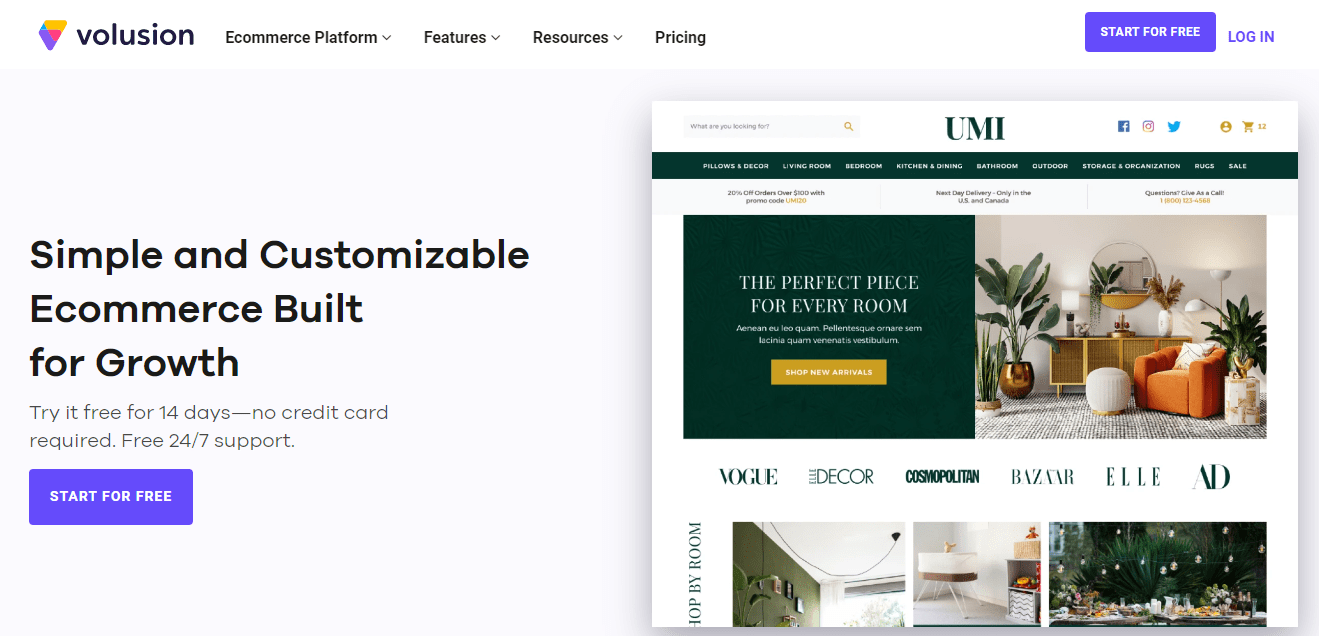
Last but not least on the list of ecommerce platforms is Volusion. Like Wix, this website builder is designed to help vendors set up their shops quickly. You get to avoid any of the coding or other technical challenges typically associated with web development.
Volusion’s no-coding setup process makes it approachable for all vendors regardless of their technical experience. However, if you’d prefer a heavily personalized online store, you’ll need to work with Volusion’s in-house design agency to craft something more to your liking.
The tool also provides a checkout solution that helps reduce cart abandonment. For a better customer experience, Volusion provides product video options for better visuals on product pages.
You can also use their suggested products feature to optimize sales on your product page. Unlike other ecommerce platforms like Shopify, you will not need a third-party integration for this function.
One major downside to this tool is that you cannot sell digital products like eBooks, digital art, or music. This limits the types of ecommerce businesses that can use this platform.
Volusion offers a Premium Theme Plus package that includes a premium theme, professional installation, Google Analytics installation/migration, and straightforward customization within the parameters of the theme you selected.
Users can also integrate their stores with other ecommerce tools like Google Analytics to access Google’s powerful reporting capabilities, etc.
Pros
- Multiple payment gateways with no platform transaction fees
- Has great reporting and analytics
- Has a mobile application
Cons
- The plans are a bit pricey compared to competitor ecommerce platforms
- No blogging feature
Pricing
- Personal: $35/month
- Professional: $79/month
- Business: $299/month
- Prime: custom pricing
Customer support
Live chat, phone support, Volusion Help Center, and Certified Agency Partners.
Which is the best ecommerce platform for SEO?
The best ecommerce platforms for SEO (Search Engine Optimization) give you control over the elements that drive organic traffic. SEO tools for editing URLs, creating clean permalink structures, customizing title tags and meta descriptions, and increasing page load speeds.
WooCommerce is often considered the best SEO ecommerce platform overall. It’s built on WordPress, which supports a variety of plugins and gives you complete control over every technical and on-page element of your site.
Shopify also has strong web performance, covers SEO fundamentals well, and its app store has a variety of SEO tools. BigCommerce takes a different approach by offering built-in marketing tools for tasks like structured data and editable URLs.
Most hosted website builders, such as Wix or Squarespace, have rather limited SEO capabilities but compensate with other marketing tools, especially for social media channels. If ranking well for search engines and AI tools is your top priority, SEO support should be considered first.
Ecommerce platforms: Wrap up
While each of these 10 best ecommerce platforms is among the industry leaders, the right solution for you depends on several factors, including your team, your sales volume, and your goals for the site.
Wix and Shopify, for example, are all about making the web design process more approachable for new vendors and smaller businesses. You can use these platforms to quickly set up an online store and start focusing on sales and marketing.
Platforms like WooCommerce and BigCommerce are more complicated to use. Of course, you can always customize your ecommerce solution to your business needs by working with an agency or adding third-party extensions to your site.
No matter which ecommerce platform you end up using, keep in mind that Omnisend offers deep integration with most of these services. You can also set up custom integrations through the Omnisend API.
Get started with Omnisend today & drive sales on autopilot with pre-built automation workflows
Quick sign up | No credit card required
FAQs
What is an ecommerce platform?
An ecommerce platform is a content management system that is used to keep track of purchases and product catalogs and maintain user relationships with online retailers. It’s the commerce engine that enables businesses to offer products and services to their customers remotely through online stores.
What is a self-hosted ecommerce platform?
A self-hosted ecommerce platform is where you host your ecommerce website on your servers. This gives you full control over your website design, outlook, and functionality. However, with a self-hosted platform, you’ll also be responsible for all your software updates, server management, and website security.
Which is the best ecommerce platform for complete beginners?
Besides being a popular ecommerce platform, Shopify is also the best one for beginners. It offers an intuitive interface that allows users to easily manage their online store even without any technical expertise. It also provides resources like guides, tutorials, and webinars to help users learn their way around faster.
Which ecommerce platform has the best free plan?
WooCommerce is the best ecommerce platform for free use. Their core software costs nothing, has no transaction fees, and is customizable. However, you’ll need hosting services to use it, so a free plan from a website builder like Wix might be a better choice if you can’t self-host.
What is the best enterprise ecommerce platform?
Adobe Commerce is the best ecommerce platform for enterprises with technical resources. This is because most enterprises require heavy personalization, and this tool offers just that. With a team of skilled developers and coders, you can create a robust ecommerce platform that suits your business needs with Adobe Commerce.
Which ecommerce platform is best for SEO optimization?
The two ecommerce platforms that offer the best SEO optimization capabilities are Shopify and BigCommerce. You can edit URLs and metadata on both platforms and optimize the content on your blog sections. Their SEO tools also provide integrations with Google Console and Google Analytics for SEO.
Which is the cheapest ecommerce platform?
WooCommerce is free for WordPress users, and PrestaShop’s core software also comes without any cost. However, these platforms require paid hosting, which might get more expensive or complicated when bought separately. Affordable ecommerce site builders that include hosting, like Wix or Squarespace, start from $17 and $16 per month, respectively.
Which is the most secure ecommerce platform?
While all the popular ecommerce platforms on our list are safe, much of the responsibility lies with the merchant who implements the features. BigCommerce and Shopify are often recommended for small businesses as they offer ecommerce features for security out of the box. Enterprises will find Adobe Commerce (Magento) best for security customizations.
Which is the best ecommerce software for dropshipping?
Shopify is widely considered the leading ecommerce software for dropshipping. It’s rather easy to start and scale your ecommerce store as it grows, thanks to its large app ecosystem. Other alternatives are WooCommerce, BigCommerce, Wix, and others, depending on whether you need hosting and ecommerce website builder features.
This article was researched and written by our experts following a precise process.
See the process
![How Much Does a Business Phone System Cost? [2026 SMB Guide]](https://programmerschallenge.tech/wp-content/uploads/2026/07/How-Much-Does-a-Business-Phone-System-Cost-2026-SMB-768x432.jpg)